Showing posts with label cremation. Show all posts

Thursday, July 18, 2013

The Interment of A. Ramana

March 2010
hindu ceremony death
Richard Clarke, a spiritual seeker, ex-patriot living in India, and a dear friend of The Daily Undertaker, has graciously shared his experiences with us twice before, in the preparation of an Indian village funeral car, and more recently, sharing the story of a friend's cremation and all the wonderful rites that accompanied it in 'Sarasvati's Ashes'. Nothing has prepared me, however, for the wonder I experienced in reading his account of a Western Holy Man's interment, and the many moving rituals that were performed in memory of this man, A. Ramana, formerly known as Mr. Dee W. Trammell. What is most moving to me in the story and photographs, is the reverence, care, and love shown to this man's remains and the participation of friends and loved ones in rituals that are at once completely new to me, and yet, universally understandable and resonant. Richard's posts on the rituals surrounding this man's passing reminds me of what is important in funerals, and why I continue my work as an undertaker. I encourage my readers to visit the original posts, The Interment of A. Ramana into his Samadhi, and The Shadra of A. Ramana in Tiruvannamalai for many more incredible photos and a more complete explanation of these rituals.
hindu ceremony memorial
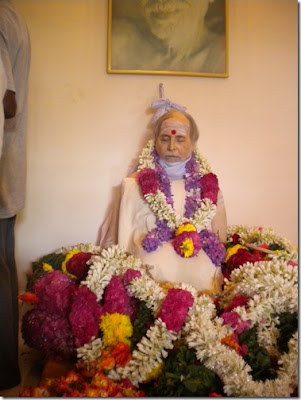
Although most people are cremated in India, revered spiritual masters such as A. Ramana are buried in an position of meditation inside a brick lined vault. The bodies of such masters are considered to be temples, and after burial, temples are indeed built on top of their graves. Apparently, only four people of Western origins have been honored in this way in the Tiruvannamalai area.

hindu ceremony cemetery cremation
After having sat in state, as shown in photo at the beginning of this post, A. Ramana, is placed on a platform, and is anointed with a series of meaningful substances including rosewater, milk, honey, turmeric, sandalwood and ash. After each substance is poured over him, he is ritually washed with water.

hindu ceremony death corpse
Ritual washing is an important practice in Hebrew, Moslem, and Christian traditions as well. In early American times, neighbors and relatives performed this ritual. Today, for many Americans, Funeral Directors perform this task, along with embalming. Whether it takes on a religious significance or not, as a funeral director, I see it as a final act of caring for the dead. We all die. Why not take the time to bathe the dead before they are laid to rest?

funeral hindu cermony ritual memorial
Following this, he is dried and dressed in white cloths, placed in a large fabric bag, and lowered along with the platform, by ropes into the grave. Throughout the whole process, there is a great deal of chanting, incense burning, as well as participation and observation by a large group of friends and associates.

Hindu ceremony repast death corpse
The bag in which A. Ramana was placed, as well as the brick lined vault, are filled, layer by layer with holy leaves, flowers, sand, camphor and ash. Inch by inch this grave is filled with these layers of substances intended to preserve the body and express reverence and tender feelings. Throughout the process his head and body are re-adjusted to remain in the proper position.

hindu ceremony repast
At this point, his head is nearly covered, and a long piece of bamboo is used to keep track of where his head is, as it is believed that the spiritual energy of A. Ramana will flow out from his head. This is vitally important to the future construction of the temple above the vault.


Hindu ceremony burial cremationTen days later, this altar and lingam has been constructed above the vault. The following is an excerpt from Richard's blog post:

In India there are two main death ceremonies, one done on the day of the death or the day after, and then a Shradha, a ceremony where food is offered, usually occurring 10 – 14 days after the death. I suspect that one reason for this ceremony is so people who were unable to come immediately after the passing of the body are able to come and join the rites.
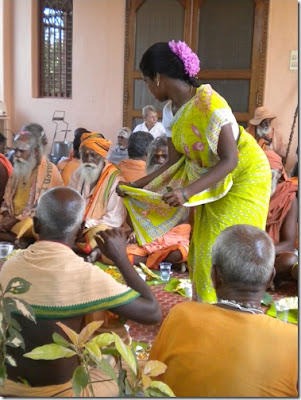
The Shradha consists of an elaborate pooja, with people close to the deceased playing key parts in the pooja, and then a food offering. If the Shradha is held for a villager, the food offering would be to the crows (symbolizing the spirits of ancestors). For a holy man, the food is usually offered to sadhus. This is what was done for A. Ramana. In a Shradha for a villager, the key role would be played by the person’s son. With A. Ramana, this role was played by two key people in his life in India: Jan, who runs the Tiruvannamalai AHAM ashram, and Vivian, A. Ramana’s personal attendant for the last several years.

Hindu cermony_death_funeral
Friends and associates gather prior to the shradha.

Hindu_Cermony_Death-funeral-ritual
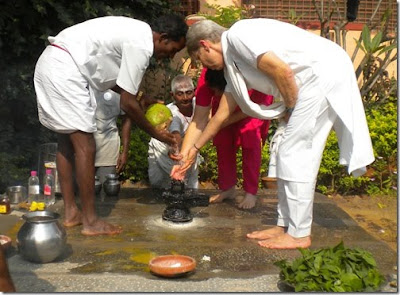
Similar to the anointment and washing of A. Raman's remains, the lingam is anointed with a series of substances and washed with water after each one. Those closest to A. Ramana are physically involved in each step. The milk, turmeric, fruit, rosewater, ash, honey, etc., and water flow through their hands and then onto the lingam, which is positioned directly above A. Ramana's head. Next, and incredible series of flower wreaths, photos and fruit are placed around the lingam.
hindu-cermony-ritual-washing
After the shradha, comes the food offering. I can't look at this photo without remembering some of the countless funeral lunches I have attended. In my community, the meal is mostly about fellowship and sharing stories. In this part of the world the emphasis is providing hospitality to others and gaining their blessings. In addition to the meal, these holy men are honored with flowers, and given clothing and money on behalf of the deceased.

hindu-cermony-funeral-repast
Following the food offering, those attending the ceremonies go their separate ways, but first, many stop to pay their respects once more.

hindu-ceremony-buddhist-death
Finally, from Richard's post, here are a few words written on the occasion of A. Ramana's death by someone close to him. I think that they speak beautifully about not just the phenomenon of death, but about our connection as humans to one another. No matter what our culture, our traditions or our spiritual perspective, in our humanity and caring for each other, we are all the same.


Everything is ended!

The wave has merged with the Ocean,


proving and assuring – once again –

that the Ocean alone exists


and that waves are part &


parcel of the Ocean!

Saturday, July 14, 2012

Promession: A Return to the Living Soil


TUESDAY, SEPTEMBER 30, 2008


Susanne Wiight-Mäsak of Promessa AB Promessa Organic AB of Sweden is developing a new method of disposition for the dead called 'promession'. Promession is described as an environmentally friendly form of burial, and could in fact be the greenest of green disposition options. In addition to its green credentials, promession is offered as a more ethical option than cremation or burial. Susanne Wiigh-Mäsak, biologist and head of operations at Promessa Organic AB recently gave a very interesting and inspiring presentation at the 90th annual convention of the Cremation Association of North America (CANA) and agreed to discuss promession with me for this post.
The process of promession involves a promator, freezing human remains in liquid nitrogen (a byproduct of the compressed oxygen produced already for medical purposes.) Once frozen, the casket and remains are agitated with a shaking motion from a table below them, causing them to shatter into tiny pieces. These pieces are then freeze dried to remove all the moisture from them. Metals are then separated, and after being laid in a biodegradable coffin can be buried, returning all the nutritious components to the soil.
I asked Ms. Wiigh-Mäsak how she came to develop this process. She is both a biologist, and an engineer, and has been keenly interested in gardening and science since youth. A special interest has been composting, and she is careful to point out the difference between decomposition and rotting. According to Ms.Wiigh-Mäsak, proper composting involves decomposition, which requires the same conditions that sustain life: air, proper moisture and proper temperature. These conditions allow for a substance to break down to the nutrient level that can replenish the earth's living soil, and are necessary for enzymes and microorganisms to do their work as well. The alternative to decomposition, says Wiigh-Mäsak, is rotting. Rotting occurs when the remains are too large for the air and soil to act upon their surface readily enough to break down in a positive manner. In the case of rot, the body's substances return to the earth, but not in a form that is enriching and replenishing to the living soil.
Because of her deep interest in composting, Ms. Wiigh-Mäsak was struck by the idea that kitchen scraps are treated with more reverence than the bodies of our loved ones. The nutrients of an apple core, that have been taken from the earth, can be returned to it through proper composting techniques, but the six and a half billion human bodies that have drawn life from the living soil are destined to burn off, rot away or lock away their nutrients, rather than return them in a positive way to the earth.
1. The corpse is frozen down to -18 °C.

2. The coffin with the deceased is lowered into liquid nitrogen. The body becomes very firm and brittle.
3. The coffin and the body are exposed to a light vibration, disintegrating into dust.
4. Mercury and other metals are separated using an induced magnetic field.

5. 25 - 30 kg of the powder now remains. This is put into a coffin made from maize starch or potato starch.


6. The starch coffin is buried shallowly and will turn into compost in 6 - 12 months' time. A tree can be planted on the grave. It will then absorb the nutrients given off.

Combining her interests in biology and engineering Ms.Wiigh-Mäsak developed the promession concept. She argues that this process in essential for the health of the living soil as well as an appealing and respectful disposition of the dead. According to Ms. Wiigh-Mäsak, even direct burial in a shroud is not as positive for the earth because the mass of the body, and the amount of moisture left in it prevents proper decomposition and results in rotting. What is truly different about promession is the process whereby the body is broken down to a point where the proper composting and a positive return to the living soil is accomplished.
Ms. Wiigh-Mäsak describes the actual physical process of promession to be something that is appealing to witness, a process that even a small child could watch and not be disturbed or frightened.

Susanne Wiight-Mäsak of Promessa AB
So, how far away are we from having promession as an option to choose from? Promessa is currently preparing for operations in South Korea, where laws have been passed to allow for this form of disposition, and promession has been embraced by the Christian Church there. Sweden is also getting closer to allowing promession as an option. Leaders of many religious denominations have determined that promession is consistent with the tenets of their faith. As far as the future of promession in North America, laws must be passed to allow for promession, and Promessa is currently in the process of selecting licensees and promession providers.

For more information on Promessa AB and promession visit the web site at http://promessa.se/index_en.asp

Monday, July 9, 2012

Sarasvati's Ashes

1/13/10 
Hindu Ritual death ceremony cremation
A van, adorned with flowers carries Sarasvati and friends to the cremation grounds

It is my pleasure to share with you the experiences of Richard Clarke, a spiritual seeker and expat living in Tiruvannamalai, India. Richard writes beautifully about his experiences observing, and engaging in Indian village life. In November 2008, I shared photos from Richard's blog 'Living in the Embrace of Arunachala' documenting the preparation of a funeral vehicle. Recently, Richard wrote to me that one of his fellow seekers and expats passed away, and he wished to share his experience with the readers of The Daily Undertaker. On his blog, he has documented the experience from death, through preparations for cremation, the procession, the cremation, the gathering of cremated remains, all the rituals involved in each step, and finally the scattering of the remains. I have included photos and excerpts from his posts, and I strongly encourage you to follow the links and read the full story yourselves. There is a beauty of completeness, affirmation of life, acceptance, and generous, meaningful participation in this story, that may change your view about the rituals surrounding death. It has certainly enriched my understanding.


"In India, when this happens, events move fast. There is a most powerful tradition that the body is to be cremated that day. So I, accompanied by Rajan, our driver, the person who gave Sarasvati the most support over the last few months, had to go to the police and to government offices to properly register the death. Meanwhile, Carol, helped by other of Sarasvati’s friends, waited at her apartment to prepare the body."

Hindu Ritual death ceremony cremation
Rickshaw Drivers, strangers to the deceased, stop their work to help with the cremation rituals.


"I have to again say a few words about the rickshaw drivers. These men are thought to be “low class” by many Indians and Westerners. What we saw this day was how they stepped in and took on the role of family to Sarasvati, a Westerner with no family here. They did this readily and freely, without asking for anything. They were loving and unstinting in their care for Sarasvati on this day. I offer them my deepest thanks. "


Hindu Ritual death ceremony cremation
Taking on the role of eldest son, Richard lights the pyre

Hindu Ritual death ceremony cremation
The cremated remains are later gathered from the ashes of the pyre.
Hindu Ritual death-cremation
Scattering the remains in the river.


"I stop for a bit, to say a last farewell to the body of a friend and fellow spiritual seeker, Sarasvati.
I then look once more at the peaceful and beautiful waters here. My thought is that I too may be blessed to die with Arunachala, and maybe this is where the last remains of this body will be placed."
Now we can go home, take our morning baths and eat breakfast."

The rituals and practices described and pictured in Richard's account may seem foreign and strange to us, and many of the procedures, such as fueling the fire with tires, kerosene and cow dung, would not necessarily be acceptable in the West. However, what translates beautifully is the power of the participation of friends in the rituals surrounding death and disposition. In Richard's account we experience the fullness and completion of the necessary tasks that bring us from the experience of death, back to life. I would argue strongly that those necessary tasks include ritual just as much as disposition, and participation in each is powerfully healing for those who grieve.

For the full posts and many more photos, please visit:
and

Thursday, April 5, 2012

Future of Cremation Rituals at Risk


Kathmandu's authorities prepare to spend millions on an electric-powered crematorium to safeguard the health and safety of surrounding communities. An Indian conglomerate has won the tender, splitting local communities who fear that an ancient tradition will be lost.

Read more: http://www.smh.com.au/world/ritual-of-last-goodbye-in-kathmandu-20120405-1wff6.html#ixzz1rBAkcxqn

Sunday, November 13, 2011

Earth Friendly Coffin for Pets


French designer, Arthur Tricheliu has created a sustainable and user friendly coffin concept for pets.  Designed with the intent of helping children deal with their loss, the coffin has incorporated a planter on the lid.  After the coffin is 'planted' , a tree can grow in memory of the pet.   


While similar products have been proposed for the burial of cremated remains, this is the first I've seen designed for the intact burial of pets.  The round design will be appreciated by anyone who has experienced burying a pet on their own; a curled up position is sensible for pets and comforting for their human survivors.  


This kind of coffin would be more appropriate for burying on one's one land than at a formal pet cemetery.  Certainly not everyone wants to bury their own pet, but for those who do, Mr. Tricheliu's design would allow for real participation, and the comfort of an enclosed container, in an earth and pocketbook friendly product.


The coffins are still just a concept, but I can easily see the addition of a smaller model for use with cremated remains, and opportunities to market to both pet stores, veterinarians and pet funeral providers. 


If you'd like to see more of Mr. Trichelieu's work, or are interested in helping to bring this product into production, visit his site.

Designer Arthur Tricheliu

Friday, November 11, 2011

Silent Souls


Films that deal with the realities of death are few and far between. Those that also explore grief and funeral rituals are very rare indeed.  The 2011 release, Silent Souls does all of this in an elegant, gentle and thought provoking manner.   This compelling story about the Merja of Russia, allows us to understand some of their traditions and funerary rituals. In doing so, we are also allowed a new understanding of the human condition and of our own needs in life, grief and death.


Directed by Aleksei Fedorchenko, and based on a novel "The Buntings" by Aist Sergeyev, Silent Souls chronicles the thousand mile road trip of two friends.
When Miron’s beloved wife Tanya passes away, he asks his best friend Aist to help him say goodbye to her according to the rituals of the Merja culture, an ancient Finno-Ugric tribe from Lake Nero in West Central Russia. Although the Merja people assimilated into Russians in the17th century, their myths and traditions live on in their descendants’ modern life.


The two men set out on a road trip thousands of miles across the boundless land along with two small birds in a cage. Along the way, the funerary customs and traditional beliefs of the Merjans, are slowly revealed. In their conversations and memories, their defining relationships; Miron's with his wife Tanya, and Aist's with his deceased mother and poet father, bring life and meaning to the world view that is their ethnic heritage.


This film is remarkable in its gentle unhurried pace, and breathtaking cinematography, and in the volumes of information conveyed by the subtle actions and limited speech of its characters. Most compelling though, is the degree to which this film brings into focus the vital importance of  our participation in rituals and traditions.  Ultimately, those actions provide us with essential sustenance; giving us of our sense of self and our place in the world.


For more information about this remarkable film, visit 

Sunday, May 22, 2011

Trimming the State Budget with Cremation

Chain Gang Burial

Cremation, once considered by a majority of Americans to be a punishment worse than death itself, has now been embraced so widely that in many areas of the United States it is the prevalent form of disposition.  A recent post, Buried by a Chain Gang, highlighted the incongruity of indigent people being accorded  a level of care and ceremony in their state sponsored burials that many wealthy Americans have chosen to do without.  This window of incongruity is, however, closing fast.

Rhode Island Governor, Lincoln Chaffee's recent proposal to cremate the indigent persons in the state's care and custody is a step that will inevitably be taken all over the United States.  States have historically borne the ultimate responsibility to provide the minimum level of a dignified disposition for those who die under their  auspices, and now that our culture's conception of a dignified disposition has been lowered, the treatment of the indigent will drop accordingly


Exceptions will be made for those whose religious beliefs prohibit cremation, but elected officials will not be able to justify for long the provision of a higher level of death care for prisoners than what is selected by the majority of their constituents.  Again, it is not as though the indigent wards of the state have enjoyed fancy funerals; they are and have been provided with the cheapest possible direct burials that can be performed.  It's just that society's standards have dropped even lower. 

Saturday, January 15, 2011

Ashes on the Sea: A conversation with Ken and Anya Shortridge

Ashes on the Sea is a San Diego based company that has been providing ocean scatterings of cremated remains since 1997.  Proprietors, Ken and Anya Shortridge are leaders in their field, and have helped many families to create meaningful and memorable rituals in scattering their loved ones remains at sea.  They have graciously agreed to share a conversation about their work on The Daily Undertaker:   

Ocean Scattering Ceremony


Pat McNally: Have you seen an increase in the number of people who choose to scatter at sea since starting your service?

Ken & Anya:  Yes, undeniably. 

PM: What are some of the ways people choose to place the ashes into the sea?  Could you describe for us how this takes place?

K&A:
  • This is usually one of the first questions families ask us about. On most of our services, the family chooses the “basket” method. The ashes are placed in a lined basket – we have plastic liners as well as the basket can be lined with green plant leaves. The ashes are placed in the basket. Rose petals are then placed over the top of the ashes. We usually arrange the basket as soon as the family begins boarding, as the basket is really quite lovely to look at while motoring out, much nicer than a temporary urn. We have a mechanism attached to our baskets which allow the basket to be lowered down into the water, and then just beneath the water line the basket is tipped. The ashes flow out, the rose petals float to the top for a beautiful display. This method also minimizes issues with the ashes blowing back into the boat and onto the guests.
  • There are various biodegradable urns on the market, such as Journey Earthurns, Shell urns, Batesville urns, just to name a few. Sometimes the family comes to us with one they have already purchased. We also have them available for purchase if that is what the family wants. The urn is placed in the water, or lowered down. It usually does not take long for the urn to sink. Flowers are then placed in the water afterward, giving everyone a display to look at. This method is usually chosen by families whose religious beliefs require the ashes to all go in together, not scattered. Other families choose this when they are particularly sensitive to seeing the ashes at all.
  • Other families choose a vase to pour out the ashes, instead of using the plastic bag inside their urn. The ashes are transferred from the urn into the vase, rose petals are placed on top, and at the location of disposition, are poured out. This actually allows for some very ornate “ash clouds” beneath the water, especially when visibility is very good.
  • One of the most unique methods using the basket we have seen is where the family puts the ashes in the basket, but then passes the basket around to the whole family. Each family dips into the ashes with either their bare hands or by using a sea shell and scatters the ashes like that…


Ken and Anya Shortridge


PM: For many of your clients, is this the only memorial ceremony they will participate in?  What percent have already and a funeral or memorial service?

K&A: Our families come from both sides of that story. We don’t have an actual percentage, but would estimate about 75% of families have already had a previous service. Now they just want something simple for the very immediate family. On the other hand, in 2010 we noticed and increase in families coming to us where this is the first and only service. We are hoping that, by providing funeral directors with detailed information about our services and developing a trusted relationship, they will be able to set it up from the outset, especially when they know that the family is planning to scatter the ashes. Families may feel rushed to come to a decision quickly, leading to more than one service. But if that is what they want, more power to them. Of course, in today’s economy, it may be more cost effective to hold one service.


Waters of the Pacific Ocean


PM: Do you work along with funeral homes, or do families usually come to you after the funeral home’s involvement is over with?

K&A: Most of our families come to us after the cremation has taken place or is scheduled to take place. We initiated a project in 2009 which generates a “final disposition” letter to each funeral home that originally served our families. This has resulted in much more interest directly from funeral homes. The letter contains the decedent name, date of death and a copy of the disposition information, including GPS coordinates, for the funeral home file. We think it is important for this information to be kept in the file at the funeral home, because if family members come looking for information about the decedent in the future, the funeral home is the most likely place where they will look first. 


PM: I see that you work in conjunction with Eternal Reefs- what type of services do you offer along this line and what have been your experiences with it?

K&A: We are an Eternal Reefs provider and have gone back to Florida to train with George and the crew for some exciting projects that we aren’t at liberty to discuss yet J. We can say that our five-weeks of experience back east were extremely exciting. We were able to take part in every step of the Eternal Reefs process: The casting, where the families come and help to build the Eternal Reef ball. We got to see a military honors for one family, which takes place when the reef balls are being loaded onto the vessel. Also, the dedication and placement, where we joined the families in placing the reef balls at sea. In our years of experience with the different ways to have a “burial at sea,” the Eternal Reefs process and service involves families the most. All of the families disembarking the boat after the placement were very satisfied and happy. 


Eternal Reefs Project


PM: What is the value for families in participating in a service like yours?  What kind of benefits have you seen, or comments do you receive?

K&A: The peace on the water has to be one of the biggest benefits. The feeling of being out at sea in the wide open fresh air brings a sense of relief and calm that you cannot experience in a room or next to a gravesite. Rarely has a family come back to the dock gloomy. On the contrary, they are laughing, appreciative, and even taking pictures with the captain and boat.

Financially speaking, scattering at sea is one of the lowest cost disposition choices.

“This is just what he (she) would have wanted” and “This is exactly what we were looking for” are comments we receive all of the time. We have a drawer full of thank you cards and notes, emails, and Google Places messages sent from the families. Many of our families keep in touch with us because they have become like family. We often get families who come back to us years later when the need arises again…


Biodegradable Wreath


PM: Have you seen any changes in the types of ceremonies or the level of family participation in services since you started in 1997?

K&A: For sure. Families want to participate much more, and more often now call with specific ideas and plans. Frequently, the family wants more guidance (It is typical to hear “I have never done something like this before”), and we provide that to them. We present each family with our “Family-led Services” booklet that helps guide them in the direction they feel is right.

Sometimes families want to involve their children, but they do not know how. We recommend involving the kids from the beginning, based on age and maturity. We often suggest creating a biodegradable wreath together, and provide step by step photo of how to make one. Another way to encourage participation in the service is to have family members, including children, compile photos and memorabilia for scrapbooks and other memory projects which can be brought to display on the boat. The “unique” service is really becoming the norm. Families are more particular in the way they honor their loved one. And that is the way it should be!

Cremated Remains wrapped in a water soluble material are released into the sea 


PM: Have any families made requests that surprised you or inspired you to broaden your range of offerings?

K&A: Absolutely! We are all across the board with this one. A few years back we had a family that brought a detailed, balsa wood model of Viking Ship. They envisioned putting the ashes in it and lighting the wooden boat on fire. They wrote notes on rice paper, put little biodegradable trinkets in the boat. We scattered the ashes and then let the boat sail away… Since then we always suggest the rice paper notes to our families and it goes over really well. Rice paper is a food product and thus is biodegradable.

PM: In my work as an undertaker, I often see a sort of emotional arc taking place with  a lot of emotional tension building up before and during a service, which is released towards the end and at the grave, or reception following the service.  Have you noticed anything like this in your work? 

A wake of flowers and ash


K&A: Generally speaking, people come to us in a good state of mind. The emotion comes out almost surprisingly when the boat gets on location and while the ashes are being scattered. There is almost always at least a span of 10-15 minutes or so of complete silence, reflection, and tears. Great emotional outbursts are not common. Lots of tender embraces, sighs, and bringing up old stories are the norm. On the way back in, things are usually pretty happy and jovial. You could say that it is usually more solemn headed out, and at peace coming back in.

PM: In your opinion, are funeral homes currently providing families with the kind of services that are meaningful and helpful to them?  Do you have any ideas on how we could do a better job?

K&A: Honestly, we don’t know what all funeral homes are offering, but we’ve definitely noticed a shift in various funeral publications and blogs focusing on the need for change in the industry. The current financial situation, as well as changes in consumer  beliefs/feelings as to what is a “proper” funeral, requires all of us in this industry to look at other ways to create streams of income while still serving the needs of families. This is one reason why we do not have a hard and fast “service.”

You will be glad to hear that almost every family that comes to us is satisfied with the service they received at the funeral home. This is good.

Can we speak frankly? Here is our main frustration: Although we don’t “know” this to be true, we “feel” as if we may be looked upon as competition. But there are so many ways we can actually compliment the services offered by the funeral homes, and our services are always discounted to funeral homes. So, the funeral home has a choice to either let the family call us directly, or sell the service on the spot. The latter is what we would like to see happen, so that the family doesn’t have to talk to so many people and the flow of information and discussion runs smoothly from beginning to end.

We have flyers (PDFs) all ready for funeral homes to be handed to the families for each of our boats and services.

Most of our families that come to us have found us on their own using Google, meaning when they left the funeral home they did not know which direction to go. Perhaps the funeral home did not know of the family’s wishes for a scattering at sea. Or is it that the F.H. did not know how to educate the family on their choices? Do most funeral homes feel their job is “done” at cremation? We don’t know. We would like to know. In any case, we believe we would all benefit from more of collaboration, and it is the families who will benefit the most.

On the Sea


PM: You operate in a kind of niche market and must function as a kind of ‘destination’ business as well.  I imagine that not everyone would entertain the idea of an ocean scattering, but that those who do become passionate about it.  Similarly, many who live in landlocked areas may never even consider this option.

Do you have many clients who come a great distance to use your services?

K&A: Yes! We have had people email us or call us from England, the Netherlands, Germany, and other countries. The one that stands out in our minds, though, is the little lady who came all the way from Japan. Her husband’s favorite destination was San Diego. She came in on the flight with his small urn, went out on the service, and then flew back home the same day. On the other hand, most of our out of state services come from Arizona & Texas, coastal California being one of the closest and most temperate vacation spots for nearby states. Last reporting year, 4 of our services came from outside of the U.S.

PM:  Do you see death care as fragmenting out into more individualized niche options in the future?

K&A: Yes, it is really the way things are going. Green Burial, Home Funerals, Burial at Sea, and even more creative options are already here or coming (Turn your loved one’s ashes into a record album?)


PM:  What do you find to be the most beautiful or powerful part of an ocean scattering experience, and why should people consider it for themselves or loved ones?  

K&A: There are so many powerful elements to a service at sea. Let’s start with the sea itself! The sea is dynamic. It always changes and is never the same. The diverse sea life we are privileged to see changes each time we go out, and from season to season. Often seagulls come down to inspect the rose petals. We have seen large flocks of pelicans diving for sardines as the dolphins are feeding from below. We have had the dolphin come over to see what is going on wanting to play with the boat.

It is interesting that each family finds special meaning and comfort by the things they see and experience while on this journey.

More on beauty and power: Certainly, the family coming together and speaking about their loved one is a most powerful facet of the service. We have had families come together who may not have been getting along before this day. On land, you can “escape.” Not so on the ocean. There is nowhere to go. This is a good thing! A powerful thing. The ocean brings them together.

Too, when the ashes are scattered, they create a beautiful underwater cloud, with the flowers, rose petals or wreath floating on top. No “ash cloud” is ever the same. It may surprise some of your readers to visualize an “ash cloud” being beautiful, but we have found it to be so.

The peace and tranquility of the ocean, the water lapping at the boat, the swaying of the ocean lends itself to the quiet reflection of all the family as we just drift a while and watch the flowers float on and away.

It may be fitting to end with a quote from Ken from chapter 4 of the book “Grave Matters, A Journey Through the Modern Funeral Industry to a Natural Way of Burial” by Mark Harris, Dec 9, 2008


“You’re on this wide open sea on a beautiful day. Birds are flying overhead; sometimes dolphin are swimming alongside the boat. Only once in the thirteen years that I’ve been leading scatterings at sea has a family ever returned to the dock afterwards with tears in their eyes. It’s a totally different atmosphere than you have at a land-based funeral.”


My Thanks to Ken and Anya for sharing their experiences and insights.  Please visit their website for more information.  Please also visit their partner, Eternal Reefs to learn about their amazing Reef Ball projects.

For more on Ocean Scattering follow the link below for a story about ocean scattering from the perspective of a family member:

Ashes and Sea

Related Posts with Thumbnails

Contact Me

My photo
Funeral service faces a crisis of relevance, and I am passionate about keeping the best traditions of service alive while adapting to the changing needs of families. Feel free to contact me with questions, or to share your thoughts on funeral service, ritual, and memorialization. dailyundertaker@gmail.com

Followers