Showing posts with label Montreal. Show all posts

Thursday, March 12, 2009

Je me souveins: Obit TV

The cost of printed obituaries is skyrocketing, newspapers in major markets are being abandoned, and obituaries are even being prepared for both newspapers and broadcast television. So, how can we keep our death news and revitalize TV? Montreal entrepreneur Gerald Dominique has an idea, the obituary channel. Germany already has a death oriented television channel, and if Dominique's plan works out, Canada may be next.

There are certainly many options for listing obituaries local funeral home sites, as well as national and worldwide sites like Tributes.com , Legacy.comMaking Everlasting Memories, andIn Loving Memory, but the real draw for obituaries is a local and immediate one. We want to know who in our own community has passed away, and when the services will be held- no matter which funeral home is serving the family. The old joke of years past of reading the obituaries in the paper to see if we are still alive may no longer make sense to a new generation who will turn on the TV to see if they are still on the right side of the ground (do you realize how hard it is to convince someone born after 1980 that TV wasn't always in color and we used to get up to turn the channel to one of the other two choices?).


Here is an excerpt from an article on CTV:
MONTREAL — A Quebec entrepreneur is planning to bring obituaries out of the back pages of newspapers to a new home on the small screen.  Gerald Dominique hopes "Je me souviens" -- a niche network dedicated to broadcasting digital obituaries -- will be ready to begin broadcasting by the summer.  The French-language speciality channel will charge a fee to broadcast obituaries, prayers, hospitalization notices and messages of thanks.  The Quebec entrepreneur obtained a licence in February from the CRTC and has designs on expanding the channel to the rest of the country, under the moniker "Remember the Name."  "The goal of this channel is to tell stories," Dominique said in an interview with The Canadian Press.  "How many stories are lost all over the world each year -- great stories about people's lives -- those are the stories we hope to tell."

Dominique said he'd often hear about people passing away but that the information would be fragmented or cursory.  "There is always the exchange of information (among friends and family) , but it never makes it into the paper which offers only one dimension of the story and it costs a fortune," Dominique said.  "I felt the need to do more."

Dominique said the TV obits will include sound, music, photos, video, text and testimonials and will cost about the same as a newspaper obit.  Eventually, there will also be obits and memorials for more famous personalities, including political figures and celebrities.  Dominique estimates there are about 56,000 deaths yearly in Quebec, and even a fraction of those stories could provide the revenue he needs.

Obituary television is relatively new.

Etos TV, one of the world's first television networks devoted to death, launched last year inGermany with quite a bit of fanfare.  That network shows pictures and video clips of the deceased for a fee and broadcasts documentaries on related topics. It is backed by an association that represents German funeral directors.

Dominique, 44, who describes himself as a self-educated entrepreneur, is firming up plans for the launch.  He doesn't have the same type of financial backing yet as the Germans do, and Dominique acknowledges he will need some assistance.

"Certainly I'd like to have some help -- I'm not sure what kind -- but I would need some help," Dominique said. "But if the planets align, I should be on the air in July."

for the full article, visit CTV News at  

http://www.cp24.com/servlet/an/local/CTVNews/20090311/090311_obituary_channel/20090311/?hub=CP24Entertainment


Gerald Dominique

From The Montreal Gazette:

Dominique, who works as a web designer and consultant, noted the idea of putting obituaries on television came after he attended several funerals over the years that left him longing for more. With his channel, Dominique wants to give family and friends an opportunity to broadcast more information about their deceased loved ones — for an undisclosed amount of money.

David Foot, a University of Toronto economics professor and author of Boom, Bust and Echo, noted baby boomers, who are the largest demographic group in Canada, have a big influence on the funeral services market. "The baby boomers are dealing with their aging parents. So this is targeting the boomers for their parents funerals and their parents' friends funerals," he said.  Foot also noted that people in their 70s and 80s are also likely to watch a channel such as that because they watch more television the older they get.  "What I don't know is the psychological impact of something like this. Are people going to find it morbid or respectful?"

 Nathalie Samson, secretary general of the Quebec Corporation of Funeral Directors, shares the same concern.  "It would have to be done in a very tasteful way," she said. "But it could be a good idea because we see more and more tribute videos and photographs at funeral homes and on YouTube," Samson pointed out.  Trends regarding the funeral industry in Canada show families are seeking personalized and meaningful ceremonies that celebrate the life of the deceased, she noted. Her association, as well as the Quebec Cooperative of Funeral Homes, have not been contacted by Dominique about the TV obituary project.

 Dominique said he talked to a few funeral home owners who "really liked the idea".  "I think there is definitely a market for this. Funeral homes and related services don't have anywhere to advertise," he said, noting that it represents a market of $320 million a year in Quebec.  Viewers who tune into Je me souviens would also see documentaries on the life of popular or important individuals.

"My goal is that no death goes unnoticed," Dominique said.

For this full article, visit the Montreal Gazette at 

http://www.montrealgazette.com/Death/1375054/story.html


Friday, December 5, 2008

Betty Goodwin, Artist of Mourning

Vest Two 1970
Artist Betty Goodwin dies

Alan Hustak
The Gazette
Tuesday, December 02, 2008

Success as an artist didn't come to Betty Goodwin until relatively late in her life, but when she died in Montreal Monday, her reputation as one of the country's pre-eminent painters and sculptures had been secure for a long time.
Her images of floating bodies, her scarred tarpaulin installations and her solemn steel sculptures were infused with melancholy. Because of her unique style, Goodwin was sometimes described as the artist of mourning.
"You can't understand Canadian art without coming to terms with her achievements," said Matthew Teitelbaum, director of the Art Gallery of Ontario, which houses the largest collection of her work. "There was in her work an expressiveness about the quality of living and the emotion of life realized on a grand scale. One of her great achievements was to produce intimacy and grandeur at the same time. She was the ranking woman of her generation, who depicted fragility and triumph in the same breath. There is an affirmation of survival in her work, the bodies in her paintings work through and around obstacles."

Nest 1973

Betty Roodish, the daughter of Rumanian immigrants who owned a clothing business was born in Montreal on March 19, 1923, Her father died when she was 9. As a child, she didn't fare well in school.
"The only thing I was good at was making art, and back then that meant drawing geraniums," she once told a reporter. She studied graphic design at the Valentine Commercial School of Art and her first job was to design chocolate boxes for the Steinberg chain of grocery stores.
Except for one year when she took a printmaking course from Yves Gaucher at Sir George Williams University, Goodwin had no formal training as an artist.
"The strange part is that I never said I am going to become an artist," she told a biographer, "I just kept going and persevered ... I have said it many times, you push and push and push, and there is a moment when the work begins to pull you."


Sleeping / Dying Woman 1963

Her early works were strictly representational, vaguely Cubist. It wasn't until 1960 when the Montreal Museum of Fine Arts exhibited 30 of her still lifes and gloomy portraits that her art making started to attract critical attention. In 1972, her textural studies of men's vests and her enormous hanging works made out of battered tarpaulins earned her the Arts Council of Great Britain's major prize at the Third International Print Biennale in Bradford, England.
Handsome, elegant and intense, Goodwin was a tenacious artist. Her confidence in her work never flagged, and when success came, she accepted it without compromise. Her shows were planned thematically – there was the Vest series, The Swimmers, Icons and Diary of a Human Hand. In 1979, she and her assistant, Marcel Lemyre, turned an apartment at 4005 Mentana St. into a environmental sculpture.

Swimmers 1975-1985

In 1986, Goodwin was the first English-speaking Quebec artist to receive the Prix Paul Emile Borduas from the provincial government.
"She was a giant, one of the first women to achive such stature in the contemporary Canadian art world," said the Montreal dealer René Blouin, who represented her work.
"Her stature was so great, that she had a following even among people who didn't pay much attention to art. She was a very private person, and while her work was rooted in autobiography, her work was a reflection of the temper of our times.
"She wasn't only lamenting the death of her son, Paul, (who died of a drug overdose in 1976) but the cruelty of the human condition that we see every day when we turn on the television."
Goodwin was made an officer of the Order of Canada five years ago. Among her many other honours are doctorates from the Université de Montréal, The University of Guelph, and The University of Waterloo, as well as a Guggenheim Fellowship.


Artist Betty Goodwin

In 1996 Goodwin donated 150 of her works to the Art Gallery of Ontario, which has the largest collection of her work. The Gallery staged a major retrospective that year, and the same year she was awarded the Harold Town Prize.
Her husband, Martin Goodwin, a civil engineer whom she married in 1945, died Oct. 15.
In keeping with her wishes, there will be no funeral.

Thursday, August 21, 2008

Le cimetière Notre-Dame-des-Neiges


http://www.cimetierenddn.org/en/
http://farm1.static.flickr.com/97/230235438_68db5182ba.jpg
http://farm1.static.flickr.com/33/59230785_23a366b0f6.jpg?v=0


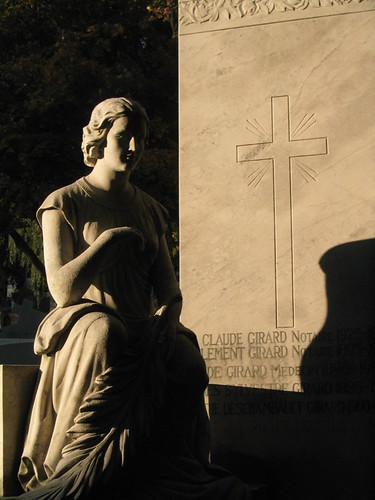
I recently had the pleasure of touring the beautiful Cimetière Notre-Dame-des-Neiges in Montreal. This is a beautiful and historic cemetery that gives lie to the notion that cemeteries are wasted space, or that we've run out of room for cemeteries. It is all about priorities. We always have room for a new strip mall or industrial park- what legacy of history and beauty do those things leave? Because this cemetery is here in the middle of Montreal, the city has a park of unrivaled beauty, with innumerable poignant works of art in many styles. Many thanks to the Executive Director Yoland Tremblay and his staff for their gracious hospitality. Follow the first link for a look at their beautiful website.


Related Posts with Thumbnails

Contact Me

My photo
Funeral service faces a crisis of relevance, and I am passionate about keeping the best traditions of service alive while adapting to the changing needs of families. Feel free to contact me with questions, or to share your thoughts on funeral service, ritual, and memorialization. dailyundertaker@gmail.com

Followers