
Is a cemetery any place for a gallery or a sculpture garden? As the Forest Hill Cemetery Historical Trust notes on their website, Cemeteries predate public museums in the United States. This makes Forest Hill, established in Boston in 1848, one of the first places the public could view art.
Cemeteries have long been de facto museums as well as green spaces and islands of calm inside busy cities. While in the past, the art on view at cemeteries has been mostly limited to memorials, gardens and architectural works, today cemeteries are also becoming the permanent and temporary homes of fine art exhibitions.
Art and cemeteries are a good combination because art has the power to help us see the world in new ways. After interacting with art, we have a new perspective on the familiar sights and situations in our life. This quality of art makes it very appropriate in this setting, where we come to contemplate some of our most challenging issues. I hope that the work shown in this post will help you to find new perspectives and convince you of the importance of incorporating art in these settings. Art brings new interest to these spaces and makes our experience there richer.
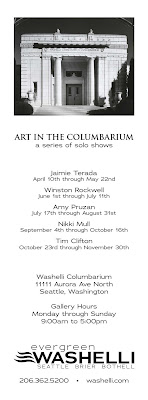
Evergreen Washelli Memorial Park in Seattle is one of the most forward thinking and community minded Cemetery and Funeral organizations in North America. In addition to historical projects and tours, Washelli hosts at least six artists per year for solo shows in their Columbarium. Currently, the photography of Winston Rockwell is on view through July 1, 2010. Rockwell has been an avid environmental photographer for three decades and has had his work published in National Geographic Magazine.
I recently had an opportunity to speak with Heather Mitchell, from the Evergreen Washelli Organization. Here is an excerpt from our conversation:
Pat McNally: What do you think the inclusion of art adds to the experience of families visiting the columbarium?
Heather Mitchell: We believe that featuring new artwork in the Columbarium adds a level of comfort for visitors, be they visiting a loved one or coming to appreciate the artist’s work. By presenting these beautifying pieces, we can promote peaceful reflection and a refreshing look at the space. We are eagerly anticipating the artwork of July’s artist Amy Pruzan, who works in a medium inspired by the concept of memory and nostalgia. Her works are mixed media: hand-blown glass pieces containing photographs, and are very complementary to the space. Her works can be shown here: http://blownawayglass.net/

What has been the response to Art in the Columbarium been like?
We have been very lucky to have received a great response to the call for submissions, and the artists we are showing are a great fit for the Columbarium. The response has been positive, and we look forward to building a rapport with local artists through the gallery. As this is only the second year the Art in the Columbarium gallery has been instated, we plan on really reaching out to the community in the future and hope for growth for the concept.

Ecola Vista, photo by Winston Rockwell
Creating a cemetery that is full of life as well as peacefulness can really help families feel comfortable visiting. This in turn allows them to continue their relationships with their loved ones.
Can art, and the increased traffic it brings, play a valuable role in creating this environment?
We believe that those who come to the columbarium to visit loved ones in our care will become exposed to new artworks, so they have something to look forward to in the monthly featured solo artists, and that those who are coming to view the art are exposed to an eloquent, possibly new-to-them, and dignified manner of memorialization. The space is definitely softened by having art on the wall, as it lends a new dimension to the Columbarium setting. It is an interesting hybrid of traditional uses for the space and connecting with local, active artists.
Have you found any down sides to these exhibits?
Due to the generous response to the call, we were only able to accommodate six artists this year, as a bi-monthly queue of solo exhibits. We hope to someday expand this into a larger rotation exhibit.
For additional information, contact Heather Mitchell or Brenda Spicer at Evergreen WashelliMemorial Park, 206.362.5200

Photo of Cinespia Wizard of Oz Screening by Aaron Magnani
Cinespia hosts classic movie screenings at Hollywood Forever Cemetery in Los Angeles. Film is of course a very relevant and vital art form to showcase in this venue. This is a very popular yearly festival, and one that helps us to appreciate and commemorate the life work of many of this cemetery's residents. Here is a description of the very popular classic movie screenings held at Hollywood Forever Cemetery, from Robby Cress, creator of the Dear Old Hollywood Blog:
This past Saturday, Cinespia kicked off their summertime movie screenings with the classic Hollywood musical, The Wizard of Oz. The screenings which occur on Saturdays (and some Sundays) during the summer, are held outdoors on the lawn of Hollywood Forever Cemetery. The cost is $10 and guests are encouraged to bring their own food and drinks.
Thousands show up early each night to picnic on the cemetery grounds and listen to the DJs playing music before the film. Then, once the sun goes down, a classic movie is projected on to the wall of Rudolph Valentino's mausoleum. This is one of my favorite things to do in LA and one of my favorite ways to catch classic movies: outside, with an audience of movie lovers, with some drinks and snacks, on a mausoleum wall that makes for a HUGE screen. http://dearoldhollywood.blogspot.com/2010/05/cinespia-kicks-of-2010-season.html
For more information about Cinespia, you may visit their website or call 323-469-1181
Forest Hills Cemetery, Boston
Forest Hills is one of Americas great historic cemeteries, as well as a leading innovator (In August, I wrote about their beautiful yearly lantern festival.) Long known for its important collection of Victorian Sculpture, the Trustees have created a Sculpture path for contemporary works.
“The Trust works to preserve the historic character of this grand Victorian landscape, so innovative in its day. However, we also recognize that this environment – which is also an active cemetery – is not frozen in time. It continues to evolve in ways that reflect the spirit of contemporary society. Our Victorian sculpture collection was modern in its day, and the Trustees of Forest Hills have launched The Sculpture Path to welcome the work of contemporary artists into this unique setting. The Path leads from the oldest parts of the Cemetery to newer areas where burials still take place.” http://www.foresthillstrust.org/path_intro.html
Here are some highlights of work from a few of the many artists who have exhibited their work at Forest Hill:

Neighbors, by Christopher Frost
Cast Concrete Buildings 2006
Artist Statement: An examination of how the places people dwell-both before and after death-reflect their lives and personalities. Cast concrete replicas of homes previously occupied by some of those interred at the cemetery are arrayed on a rock outcropping within the cemetery. The styles of the homes range from Queen Anne mansion to a modern split level. Each building has the occupation of the owner etched into it.

Nightshirts, by Leslie Wilcox
Painted stainless steel screen, Spruce, 2002
Artist's Statement: To me this is a place full of people. I want to celebrate the generations of extended families and friends that have shared these hallowed grounds for over 150 years. These "figures" are a bit humorous as they hover above the ground, as if in another dimension, almost otherworldly. Moving about in tandem with the wind, their benign nature compels the viewer to render them harmless, a gentle reminder of many communities represented in this special place. I chose these particular trees for their slender, life-size girth and random placement near an extended family plot, where several paths cross. It seems as if this group of figures almost flies above the fray, looking down at us as we look up at them. http://www.foresthillstrust.org/path/wilcox.html
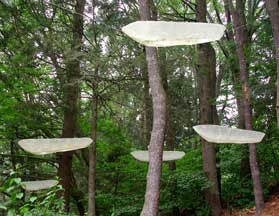
Sky Boats, by Caroline Bagenal
Fiberglas White Pine Grove, 2001-2002
Artist Statement: An outdoor exhibition space offers an opportunity to develop a dialogue between artwork and the environment that I find rewarding and challenging. I chose to create boats for Forest Hills Cemetery because of their actual use in burial rites, such as those of the Egyptians and Vikings, and their presence in myth and folklore as vessels for the soul's journey after death. Boats also have rich associations with other container- coffins, cradles, seedpods, and husks.
Suspended in the trees, moving slightly with the wind, these translucent boats become animated and authoritative. They share our space. Their location near a bridge gives us two vantage points. From below, the changing light shimmers through Fiberglas. From the bridge, we see them at eye level, floating through the air intent on their mysterious journey. http://www.foresthillstrust.org/spirits/bagenal.html

Ancestral Memory, by Gabrielle Rossmer
Acrylic resin, gypsum, Fiberglas, cloth 1999
Artist Statement: This piece is a meditation on those we've lost, as experienced in the remnants of our memories. The garment-like form that is the basis of the piece could be a portrait of an individual. But outer layers of cloth obscure all recognizable detail. The figure loses specificity and becomes universal, as personal memory blurs into collective history. The earth-toned color connects the apparition to the ground; the effects of time and weather make it ethereal. It is sequestered in the woods, suspended between heaven and earth.
For the past decade I have been developing multi-media work about my family's history in Germany during the Holocaust. I emigrated with my parents when I was one year old, leaving behind grandparents and other relatives. Trying to come to grips with a loss that knows no generational bounds, I have been deeply concerned with memory and history.

Winner Jumalon 'A Part' show
Recently in Antipolo City, The Philippines, the work of artist, Winner Jumalon was featured in a cemetery-like venue. Here is an excerpt from the blog, Snippets from the Manila Art Scene
“Winner took inspiration from the grave markers of non-Christians, like the ones found in Mindanao for instance, that define burial sites with carved likenesses of the dead beneath them. Some eastern religions also pay tribute to the deceased by keeping cherished objects close to them. Winner fabricated each piece as both a portrait and a still life, one on reverse sides of each other. He painted using automotive paint on a resin base. This allows the pieces to stand outdoors. With the help of artist Ruel Caasi, he set up the exhibit to fill the grassy knoll by the gallery’s pool, all portraits facing one side, all the still lifes the opposite”.
What is Mr. Jumalon telling us with this work? The exhibit is not in an actual cemetery, and the portraits on the front of the pieces are of living people, but the show is obviously set up to remind us of a cemetery. The visual of all these faces, individuals, with issues and concerns, and the reverse image, of all the physical objects belonging to these people, testament to their involvement in this world; these images will change the way I see a cemetery. When we look at a cemetery mostly we see the stone monuments. We are aware of what they represent, but we do not see the people. One important gift that art can bring to a cemetery or columbarium, is the reminder of the individuals; not just the people we remember, not just a number, but a sea of our forebears. Each an individual, each with his or her own unique contribution to the world we now inhabit. We accept this in our minds, but sometimes it takes art to help us to acknowledge it in our hearts.
Please visit these posts highlighting innovation in funerals and cemeteries:

.jpg)
.jpg)
.jpg)
.jpg)
.jpg)

.jpg)


