Showing posts with label casket. Show all posts

Friday, April 13, 2012

Facilitating Ritual with Design: Adam Miklosi


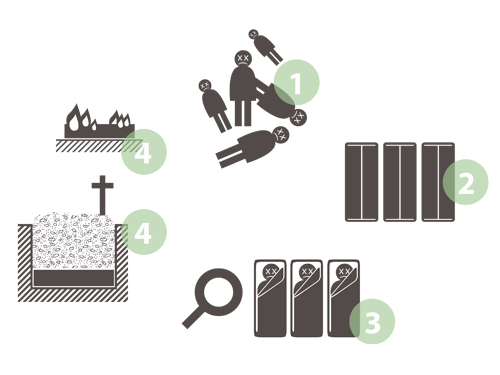
Hungarian designer, Adam Miklosi's work is a wonderful example of elegant design, combining aesthetics and function.  The functions that Miklosi considers in his LR16 Disaster Coffin address issues that previous designs, such as the ubiquitous 'body bag' have left out.   The facilitation of funeral rituals, dignity, accommodation of  variety in disposition choices, and the use of an environmentally friendly material all make this design remarkable and important.  

It is my hope that Miklosi's work is recognized and that these essential issues are considered in any future designs that are implemented for human remains.  Each person deserves this level of respect, and each family deserves the opportunity to perform their funerary rites.  Here is the design, and his statement.  For more information on Adam Miklosi, visit his site: http://www.adammiklosi.hu/?w=1280      

LR16
Special coffin for disaster situations
"...Whether dealing with violent deaths in major disasters or in armed conflict, issues concerning the socio-cultural order of a community are valid. The inability to perform rituals condemns a family to a second death: the symbolic death of their loved one for the lack of a tomb that perpetuates his or her name and confers social worth to the deceased and his or her inclusion in the generational continuity of a family."

My aim is to find a solution to the problem of the funeral after disaster situation.
I designed a coffin as a storage for the corpses, which is able to isolate the infections, isolate the corpse during the putrifaction, which protect the corpse and the people who "work" with them.

The material of the product is PLA biopolimer, 100% biodegradable.

I focused on the experiences of the relatives and gave them an alternative, to keep their loved in rest and respect. - Adam Miklosi


Monday, March 5, 2012

Funeral Home Facilitates Incredible Lego Casket for 10 Year Old Boy

An inspiring story from the Siskiyou Daily News:


A custom-designed and custom-made Lego casket – it is adorned with 26,000 Lego pieces – sits at the Fort Jones Cemetery Saturday morning just prior to young Dylan Frick’s memorial service.


Jamie Nowdesha, a funeral counselor and personal secretary at Girdner Funeral Chapel in Yreka, was instrumental in moving the month-and-a-half-long project to construct a casket for Dylan adorned with 26,000 Lego pieces along. She made the original call to the Lego organization and was the contact person for the casket manufacturer and the Lego artist who designed and created the Lego outer shell.

for the full article, visit Siskiyou Daily News
thanks to Jeff Jorgenson for the lead

Tuesday, December 7, 2010

Digital Death for World AIDS Day

On December 1, 2010, World AIDS day, the Keep a Child Alive organization’s co-founders Leigh Blake and Alicia Keys launched a creative and attention grabbing DIGITAL DEATH campaign as part of their larger fundraising effort BUY LIFE.

Daphne Guinness

Photo by Markus Klinko/ Indrani/ GK Reid
As part of the campaign, developed by TBWA\Chiat\Day New York, celebrities Alicia Keys, Daphne Guinness, David LaChapelle, Serena Williams, Elijah Wood, and others, vowed to end their digital lives and sign off from all social networking platforms including Twitter and Facebook in an effort to collectively 1 million dollars for those in Africa & India affected by HIV/AIDS.   Participants were laid out and photographed in caskets and videotaped giving their last messages before their digital resurrections.


Alicia Keys 

Photo by Markus Klinko/ Indrani/ GK Reid
On Monday, December 6th, they met their goal, having raised $1,000,495 from fan pledges and $500,000 in matching funds from billionaire philanthropist, Stewart Rahr.  According to MTV news, the idea was hatched by Keys, and she and other celebrities urged their fans to buy back their online lives by texting the first name of the celebrity they miss on social media the most to contribute to the cause.


David LaChapelle

Photo by Markus Klinko/ Indrani/ GK Reid


For more information about this project, visit 

Monday, June 1, 2009

Ask the Undertaker: Advice to DIY

DIY Casket by Joe Scanlan

Dear Undertaker - 

Being a rabid-do-it-yourselfer, I was wondering what issues there are (if any) with making my own casket? I have seen plans online and think it would be the ultimate personalization of the experience. Also, Are there any issues or tips for doing my own headstone (other than adding my expiration date)?

-Handyman in Houston


DIY Casket by Joe Scanlan

Dear Handyman,

Making your own casket can be a rewarding and challenging project for a do-it-yourselfer.  The rewards would be, as you said, the ultimate personalization.  You'd have the opportunity to make your final resting place an expression of your own taste, handiwork and artistic vision.  For some inspirational ideas for creative caskets (which would unfortunately not meet any of the specifications normally required in the states), visit my post on Ghanaian caskets 'Art and Death intersect in Ghana'.  There are some real challenges and restrictions to be aware of before you start your project.  The casket must be made within the dimensions that would allow it to fit into a standard burial vault (which are required at most cemeteries).  It must also fit inside the hearse with the handles in an open position.   A flat bed truck could be used to transport your casket if you have one available and desire this mode of transportation, but it would be very difficult for pallbearers to safely load and unload with such a vehicle.  Your casket should have handles that provide a good grip for your pallbearers (Rope handles don't work very well), and be light enough and strong enough to easily carry.  The homemade caskets I have seen usually are not strong enough to be supported by the handles, are too heavy to carry, or are too large in at least one dimension.  On the other side of the size issue, if you make your casket a tight fit for yourself now, and then gain weight before you die, your casket may be too small for you to fit into, or to look comfortable in, when the time comes.

If you desire a viewing, it's important to realize that the caskets available at the funeral home feature adjustable mattresses, pillows, and fabric that drapes over the edges. This allows the funeral director to make adjustments to the positioning of the deceased, allowing them to look comfortable while in state.  I posted a piece on the stagecraft involved in viewings in April  'Embalming Part 3: Stagecraft'.   If you are still interested and confident after reading this, pay a visit to your local undertaker and ask to take a close careful look at the features and dimensions that standard caskets have, and decide if you have the skills to incorporate them into your own casket.

In any case, at the time of death, your undertaker will ask your family to sign a waiver releasing the funeral home from liability should your handiwork fall apart on the way to the grave, or fail to fit inside the vault.


This weekend, I was at the Madison Museum of Contemporary Art's 'Return to Function' exhibit which, along with some other witty pieces, featured an Ikea style casket, by artist Joe Scanlan, that looked just like the Swedish furniture that many of us have had to put together at one time or another.  Anyone who has had to move this furniture will attest to the fact that it falls apart even without one hundred or more pounds of cargo inside.   For more of Mr. Scanlan's work visit the site of his gallery, Galerie Chez Valentin.

Making your own headstone is not quite my department, but here are some basic issues to consider:

  • What kind of materials , dimensions and footings are acceptable at the cemetery?
  • Will anyone be able to engrave information on the marker without ruining it after it's installed?
  • Who will the cemetery allow to install the marker?

Many people have their markers installed before death, and if you are making your own, I would recommend installing it and enjoying it right away.  A neighbor of mine had a boulder that she loved and was able to get the local monument company to engrave and set it for her.  It looks great.

Saturday, April 18, 2009

Embalming: Part 3, Stagecraft

Ross Hollywood Chapel, Portland, Oregon

In the two previous installments of this series, I discussed the transformation that takes place in the appearance of the deceased with embalming, and the temporary preservation that embalming allows.  Now, in part 3, I'll discuss 'stagecraft'.  Although not part of the embalming procedure, these finishing touches are an essential and often misunderstood part of the preparations for viewing the deceased.
At the funeral parlor, careful steps are taken in presentation for a family's viewing of their departed.  Usually the day before services are held, it's time for 'hair, makeup and wardrobe', or as is listed in a funeral home's federally mandated General Price List, 'Other Preparation of the Deceased'.
When we look at a person, a whole host of factors make them recognizable to us, and when any of these pieces don't match our memory, the rest don't quite fit together right.  Hair is a big one for women, and often, even for men.  Whenever possible, the funeral director arranges for the hair dresser who worked on the person in life, to prepare their hair for the funeral.  If this is not possible, we rely on photos.  It is not unusual for family members to come in to prepare hair and makeup.  This can be a difficult thing to do, but I don't think anyone ever regrets having done it.


Busby Berkeley-Stagecraft

Makeup is one of the most misunderstood aspects of preparation, and heavy handed funeral directors and embalmers are largely to blame.  In some communities, people have come to expect a 'funeral pallor' of caked foundation, waxy orange lips and greasepaint in the Broadway tradition.   I think that the fear of bad makeup is often a factor in families choosing a service that does not include viewing.   
In most cases, when the embalming work has been done well, very little makeup is needed.  Good embalming practices include the use of pigments that replace some of the reddish tones that the circulating blood provides in living tissue.  A light layer of foundation and some highlights complete this effect while leaving the texture of the skin, and natural variations in skin color and freckles visible.  Certainly there are times when more opaque makeup must be used to conceal trauma and jaundice, but good makeup work should be as invisible as possible. 
Many women have told me that when they die, they would like us to use their favorite makeup brands and colors.   This sounds like a good idea, but we are not starting with the same skin tones in death that they start with in life, so adjustments need to be made.  The majority of our work is just bringing back the original appearance of the skin as it would have looked in life before any makeup was added. Because of this difference, the foundation we use often has more pink than they would use to achieve the same effect. Similarly, a light brush of foundation and touches of red on the lips, nose, ears and eyes will make a man look like he did in life with no makeup on. 

In addition to hair and makeup, wardrobe and scene construction are a part of presentation at the funeral home.  These preparations take a surprising amount of time and skill to achieve a comfortable and well turned out appearance.  Clothing that the family brings in may or may not have fit recently, but in either case, good preparation involves alterations that make those garments appear comfortable and well fitting.  I have been told that news anchors have their suit coats altered (sometimes only temporarily,) so that they appear to fit correctly in a sitting position.  Similar steps are taken with collars and lapels for people lying in state.  Sleeves and cuffs are carefully positioned prior to placing the deceased in the casket so that the folds stay neat and attractive. 
Arranging for a comfortable appearance in the casket is another task that takes more time and skill than most would guess.  More than just a box, the casket is the setting in which a person is viewed.   Padding, mattress levels, the drape of fabric and arm supports are adjusted until the deceased is shown to their best advantage.   The skills of the undertaker create the appearance of the deceased lying at rest and comfortable in a setting that is soft, dignified and exactly the right size.


If done well, all these aspects of stagecraft go unnoticed, and the viewer is allowed to focus on their loved one.  They are not distracted by unusual skin tones, unfamiliar hair styles, ill-fitting or uncomfortable looking clothes, a stiff, awkward posture, or a setting that looks unnatural.  They see what they have come to see- not makeup, casket or artifice, but the familiar face of the person they miss the most, and the arms and hands they recall hugging and hugging them back.  They see that person at rest and at peace, and if the undertaker did a good job, they might never guess how much work went in to making everything look so natural.   

Saturday, November 8, 2008

The Case of the Catholic Casket

Giottino's Pietà of San Remigio. ca. 1365, Tempera on wood, 195 x 134 cm, Galleria degli Uffizi, Florence. http://commons.wikimedia.org/wiki/Image:Giottino_pieta.jpg
"In the winter of '95, my bedridden father was preparing for his impending death. As the town's longtime independent Baptist minister, he had helped countless families in their grief. In his mind, by taking care of his own funeral arrangements, his family wouldn't have to do a thing. So he worked it all out with his friend, Neil, the longtime mortician from the funeral home across the river. One of my seven siblings lived in town, so Dad sent John over to Neil's place to select the casket, knowing that he's also friends with Neil and his younger partner. A couple of weeks later, I was in town, and Dad asked me, the eldest, to go approve John's choice.The casket was adorned on opposite corners with exquisite wood relief carvings of da Vinci's Last Supper and Michelangelo's Pieta, one pair at each end. I reported back that John had made a wonderful choice, as I described these iconic carvings. Having seen the Pieta in Rome's St. Peter's Basilica, Dad was immensely pleased, and so was I. At Eastertime, still at home, in his last lucid moments, Dad started to tell us a funny story about kicking the bucket. Laughing with him, we asked whether he was finished with the story, but its punch line slipped away with him. Later that evening we called Neil, wanting him to pick Dad up. That he had lost a dear friend was plain for all of us to see.The next afternoon brought fireworks. A longtime member of the church Dad had served rang the doorbell, and before she was through the door, burst out, I don't understand why Carl would have Neil do his funeral. Why is Carl going across the river to the Catholic funeral home? What's wrong with the Protestant one on this side? I just don't understand! We were all startled, as Dad's choice had seemed most natural, given his long friendship with Neil. Her outrage switched on a light bulb in my mind, and only then did I catch a glimpse of the significance of what had been chosen. It was a Catholic casket. Yes, an unadorned cross had replaced the crucifix, but the casket's imagery was unmistakably traditional, very catholic, if you will. At the visitation the next day, Neil pulled me aside, wanting us to know how his friendship with Dad had started. Years ago, he had purchased a very old funeral business that had been run into the ground. That first year, he did only six funerals, but Dad knew of his plight. Neil's words to me were, If it weren't for your dad, I wouldn't have succeeded in this business. Dad had directed business his way, helping him gain the footing he so desperately needed. We children had no idea of this basis of their friendship. Then John told his story about choosing the casket. It had caught his eye immediately, as the most prominently displayed piece there. After wondering what people would think and viewing other caskets, it dawned on him that this casket would not even have been there for anyone else. Neil had specifically ordered this coffin for Dad. Surely it symbolized their beautiful friendship, and we suspect that Dad knew. The next day, with grateful hearts, we proudly followed that Catholic casket up the aisle of the Baptist church. Dad's ministry had bridged many rivers, serving non-Baptists and the unchurched, helping persons who lived on society's margins. In Neil, he had found a soulmate."


Nelson Hart for The Holland, MI Sentinel
http://www.hollandsentinel.com/lifestyle_religion/x1720644776/COLUMN-My-father-s-casket

Friday, August 29, 2008

Back to theEarth part 2

http://www.fielderschoicegloverepair.com/Home_Page.php?OpfAlbum_CurrentPageNumber_4774=2


As mentioned in Back to the Earth part 1, the idea of returning to the earth is a powerful one. Often during committal services, the sign of the cross is traced in sand on the casket, and a powerful ritual in the Jewish faith involves sprinkling dirt into the grave of a loved one. I have seen and facilitated wonderful variants on these rituals. When an elderly woman in my town passed away, her family wanted some of the earth from the family farm to accompany her into her grave. It was important for them to know that she was resting in the same earth that had been such an integral part of her life and family history. They brought a pail of that soil to the committal service, and when it was over, I invited first the family, and then friends to sprinkle some of it on her casket. The family started, some a little shy about it, but after a few people participated, everyone wanted to be a part of this ritual. I'm grateful that the family brought enough for every one to sprinkle in a handful. The lesson I learned from this was just how moving the acknowledgement and engagement of her connection to her earth was, and how healing participation can be for family and for friends.


Tragically, little more than a year later, the woman's son passed away. When I suggested sprinkling the earth on his casket, the family said that he didn't have the same connection to the family farm. The powerful connection this man had was to the local baseball field. He had grown up across the street from it, played there, watched games there, and coached his sons and students in baseball there. We processed out of the church the day of his funeral singing 'Take me out to the ball game' and out into the churchyard where family and friends will always remember that they sprinkled sand from the baseball field into his grave.

Wednesday, August 27, 2008

Final Salute


Minutes after her husband's casket arrived at the Reno airport, Katherine Cathey fell onto the flag. When 2nd Lt. James Cathey left for Iraq, he wrote a letter to Katherine that read, in part, "there are no words to describe how much I love you, and will miss you. I will also promise you one thing: I will be home. I have a wife and a new baby to take care of, and you guys are my world."


The night before the burial of her husband's body, Katherine Cathey refused to leave the casket, asking to sleep next to his body for the last time. The Marines made a bed for her, tucking in the sheets below the flag. Before she fell asleep, she opened her laptop computer and played songs that reminded her of "Cat," and one of the Marines asked if she wanted them to continue standing watch as she slept. "I think it would be kind of nice if you kept doing it," she said. "I think that's what he would have wanted."


Exerpts from an incredible series of photos by Todd Heisler 'Final Salute'

Follow the link to see the whole series, and get some tissues out.

Tuesday, August 26, 2008

Welcome Home Sgt. Fischer

Marine Gunnery Sgt. Richard W. Fischer was recently identified, after being listed missing in action in Southeast Asia during the Vietnam War. He was brought home to Madison for Funeral and Burial. This video, produced by Frogman Productions, has been the recipient of international awards.

http://www.cressfuneralservice.com/

http://www.richardfischermia.com/

http://www.frogmanproductions.com/

Thursday, August 21, 2008

Jazz Funeral 'Just a Closer Walk with Thee'


New Orleans Jazz Funeral for tuba player Kerwin James from onenawlins via YouTube

As a funeral director, watching this makes me cringe at the possiblility of the casket being dropped, but the beauty of this ritual and love expressed by it are inspiring. The video is a bit long, but I think you'll find yourself watching it over and over as I did.

Related Posts with Thumbnails

Contact Me

My photo
Funeral service faces a crisis of relevance, and I am passionate about keeping the best traditions of service alive while adapting to the changing needs of families. Feel free to contact me with questions, or to share your thoughts on funeral service, ritual, and memorialization. dailyundertaker@gmail.com

Followers