Showing posts with label military honors. Show all posts

Sunday, April 11, 2010

Yarn Bombed Headstone, Pebbles, and Seed Corn

04/11/2010
art and death
Yarn Bomb Project by Jen Cantwell

Placing pebbles on a cemetery monument is an ancient Jewish custom originating in the desert. Yarn bombing, or Guerrilla Knitting, is a postmodern urban art form. What on earth can the two have in common? They both say "I was here" in a gentle and moving way.

art and death

Last week I met with the family of a wonderful man who died doing what he loved to do- sell feed corn. His funeral plans were to have a wake in the evening so that his many many friends could have a chance to visit and say good bye to him. Again, the next day, he lay in state at church before his service. Even though he wanted to be cremated, it was important to him that his grandsons have a chance to carry him out- to participate; to honor and be honored.

art and death memorial
As we spoke about the cremation to come, the topic of urns came up, and as the man had always been frugal, his family joked that he might be comfortable in an old tin can. I joined in by suggesting that the family could knit a cozy for the tin can urn. As it turned out, the family was more comfortable purchasing an urn that was designed for burial. One that would not break down in the earth.
art and death
Even the monument's letters have cosies
Just two days later, I was sent a picture of Jen Cantwell's incredible knitted cemetery monument project by craft blogger Sarah Brazier (please check out her consistently entertaining blog The After Craft and her Etsy Shop, Flail of the Flair for many more creative ideas.) I knew I had to share this wonderful intersection of art and death with my readers.

art and death
Yarn bombing is a fascinating movement that challenges our ideas about people, art, and expression. Participants seem to revel in the perceived contradiction between knitting and graffiti. While the work may be technically illegal, or at least might require some sort of permit, it is, as the writer of the 'Deputy Dog' Blog puts it "the world's most inoffensive graffiti." Like graffiti, artists leave their 'tags' in a public place, and the art is seen in the context of the public sphere, rather than the gallery or museum. Seeing a knitted up light post or phone booth challenges our expectations of the world and our expectations of art's boundaries. Then, the fact that this unauthorized and unexpected intervention was done in such a warm, fuzzy and non damaging or intrusive way challenges us further still. We must ask ourselves not only if this is beauty, art, or meaningful; we must ask ourselves about our own preconceptions about people and the rules of public discourse.

art and death
We see here three monument cosies. Does this effect the way we see these and the rest of the monuments?
It is indeed the gentle nature of yarn bombing that makes it so subversive and challenging. If these artists had actually damaged the public and private property they act upon, they could be dismissed as vandals, but because their art has such comforting and protecting properties, we are charmed, beguiled and challenged into thinking about its message.

ritual art and death
There are many messages that can be taken from guerrilla knitting projects, and each project has its own unique qualities. One that resonates through them all, however, is the message that someone was here. A caring thoughtful person was here, and left this art for the public to freely contemplate and enjoy. One day this project will fall apart, or be lifted off, and no harm will have befallen the adorned object. Like all of us, it will pass away, perhaps without a trace. But, for now, here it is to charm and challenge us.

art and death

This brings me back to the pebble. We leave a pebble to continue building upon a monument of a friend or loved one. We leave it to bring attention to the grave, to let others know we were here, and that the person mattered. They have gone on, and perhaps in the years to come, they will be forgotten by all of the living, but for now, and until the pebble is taken away, we all see that the grave was visited and the memory cherished.

art and death
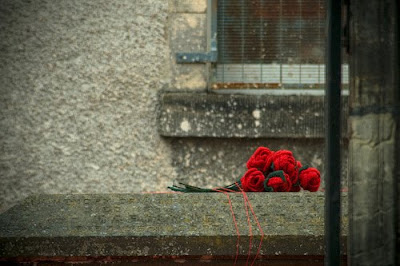
Knitted roses left on the crypt. Graffiti?

Like a knitted cozy, a pebble is a gentle gesture, but like the cozy it is powerful too. When people come to understand the power and transcendence of gentle unexpected acts, we will rejoice in a better world.

The man who sold feed corn had served his country in the Army. Following his service at church, Military rites were performed outside, and it was a powerful and moving ceremony. I then called the pallbearers forward once more and helped them place their grandfather in the hearse. I was about to close the door, when I heard music. At each of the children's weddings, this man had sang a sweet and humorous song about love, and now the family was singing the same song back to him. I stood at the hearse holding the door open while they sang. This man's faithful service and willingness to fight for his country had left a wonderful legacy for his family and our country, and so did his gentle gestures of love.


art and death memorial
Yarn bomb in front of the Tate, image from Perl Interrupted © Lauren O'Farrell, 2009.

art and death
Pink M.24 Chaffee by Marianne Jorgensen, image from the Craftzine blog

For my article on Graffiti Memorials, visit

For more about yarn bombing, visit

For more on the Jewish custom of leaving pebbles on gravestones, visit

Sunday, May 3, 2009

The Bearers of Bad Tidings


Casualty Notification Officers (CNO) of the U.S. military branches, and Doctors are regulary charged with the task of delivering the worst of news.  "Your son was killed" or "You have terminal cancer" are words that no one can bear to hear, but must be delivered by someone.  Ideally this horrible news should be conveyed with tact, clarity, and sensitivity.  The medical establishment and the military have both taken a lot of critisism about the manner in which these communications have been made, and there are efforts to educate doctors and CNOs to improve their graveside manners.  

In the case of the military, just the fact that there are CNOs is a step in the right direction.  At one time, notification of death came via the Western Union boy or a taxicab driver in the form of a telegram.  Here are two accounts of recent notifications. 

Maj. Scott Sanders, an Army officer, recently performed a casualty-notification mission for a 101st Airborne Division Soldier.  Notification duty officially begins when a Soldier receives a prepared statement and is told to inform some one's parents that their son or daughter has been killed in the line of duty. Sanders got the job when his name came up on a roster.   On his way to the parent's home, he wondered if there was any way to soften the words that would surely be the most devastating these people had ever heard. He began practicing his statement aloud and altered the tone several times, knowing there was no right or wrong way. Nothing was going to change what had happened. Sanders also contemplated rumor-mill stories that had circulated about other notifications; one family grabbed the notification officer and cried, while another refused to allow the notification officer into their home for several hours. One father claimed the notification officer was at the wrong address, refusing to believe the casualty was his son. 
"Many notifications have been made late at night, as mine was," Sanders said. The Army's concern is that some one other than an Army representative might deliver the news unprofessionally and without accurate information. The closer Sanders came to the Soldier's home, the more he prayed that no matter how the family reacted, he'd act professionally. Finding the right house was difficult. And after much futile pounding, a neighbor suggested Sanders try knocking on the back door, since the family entered and exited from there. As he approached the entrance, Sanders' stomach seemed to fall to his feet, and his whole insides ached. Then the door opened. Concentrating on the words he was going to say was difficult, he said, as a middle-aged couple looked at him, taken aback by his presence, especially at such a late hour. 
Mustering as much courage as he could, Sanders read his prepared statement, as his hands trembled. Etched in his memory forever was a father who simply stared at him, too shocked to do anything else, while the mother pounded the table with her fists in anger. -from an article by Renita Foster on Army.mil.com for the full text,visit http://www.army.mil/-news/2008/05/05/8966-for-the-families/

There is no harder task than to knock on the door of a fallen Soldier’s family.  The family sees the dress uniform and knows their hearts are about to be broken.  I have notified two families.  You receive the call when you least expect it.  The voice is almost apologetic when you are asked if you are able to perform Casualty Notification Officer duty.  You say “Yes” as your stomach sickens.  They give you the initial report.  A Soldier’s name, when he died, where he died, and the phone number of the Chaplain that will go with you. Your next phone call comes from the Casualty Assistance Center (CAC).  They are less apologetic.  I’m sure it comes from having to make similar phone calls all day long.  They give you the family’s address.  The nausea grows as the conversation goes on.  The CAC asks for your email address so they can send all the paperwork. The paperwork has a script you should read. “I have an important message to deliver from the Secretary of the Army…” 

As you get dressed your mind races.  You try to remember the class you were given on how to notify families.  You try to remember what other Soldiers have told you about notifying families.  You try to remember to breathe.
 
When I told the wife, she cried for a half hour on her couch.  I sat there in silence listening to her cries, and her repeated “Why?”  There is no answer to ease her pain, or to heal her heart.  And, there never will be. The mother answered the door and knew immediately.  I broke the hearts of the parents as they held each other.  As you sit at the table and explain the circumstances, you measure each word based on the extent it will hurt the family.  You use the Soldier’s first name.  You never use the word “remains” or “body”.  Every reference to the Soldier is spoken in the present tense.  And you hold back your own tears, as the parents ask repeatedly if there has been a mistake.  As much as you wish it was, you assure them there is no mistake.
 The second time was different, but no easier.  The Soldier was 19 years old and had been in Afghanistan for only a month.  At 6:30 am, no one answered the door.  As the Chaplain and I sat waiting in the driveway, the older brother saw us.  He knew why we were there… two Soldiers in dress uniforms at 6:30 am isn’t hard to understand. The parents were out of town.  He didn’t give me their phone number, instead, it was his sister that called the parents.  They drove 500 miles back to Michigan.  I can’t imagine the pain they felt with each mile.  When I officially notified the parents, the house was full of relatives.  The mother and father were composed and grateful.  They shared his first letter from Afghanistan, it had come two days earlier.  Casualty Notification and Casualty Assistance Officers stand on doorsteps and deliver the most heart-wretching news imaginable.  We stand there sick to our stomaches and burdened with guilt.  We stand there not as a duty, but as a commitment to the Soldier’s and the family’s sacrifice.  It’s what we would want for our family.

The question of how the CNO best communicates the fact of death to families is not a relevant point in this case because the reason for the CNO visit seems to be apparent to the family as soon as the soldiers in dress uniform are seen.  Afterward there is a protocol for how the news and details are delivered, and the demanor and emotion that the soldiers are allowed to express.  While it could be argued that more extensive training be given, the military formality and the importance that is placed upon notifying the families as soon as possible are understandably priorities that may preclude a more studied comunication of the news.


For doctors, little in the way of training or protocol has traditionally been taught in medical school,  but this may be changing as the following excerpts illustrate.

Sidney Bloch, professor of psychiatry at the University of Melbourne, has been working for many years to improve doctor training in this important but neglected area. “During my time in medical school I was never taught how to communicate with patients about matters of gravity,” he recalls. “In my internship I faced dying patients from the very beginning, and to talk to these patients and their families was extremely daunting. We defended ourselves by developing thick skins. We adopted the stiff upper lip approach. This promoted dehumanisation, and this remains the case today in our hospitals.”
Later in his career, when teaching psychiatry registrars, he saw how difficult it was for them to empathise with patients. “They hadn’t been taught how to do it and, besides, there’s a school of thought that suggests you can’t teach empathy anyway, that some people naturally have it and others don’t.” While Sid agrees that some people tend to be more naturally empathic than others, he doesn’t believe that empathy can’t be taught. But, given that empathy is a feeling state rather than something that can be memorised from a textbook, how does one teach it? Sid Bloch’s answer is to use the humanities.
Married to an English literature graduate and having studied two years of an English degree as a young man, he had long been aware of the contribution of poetry and literature to our understanding of suffering and aloneness. 
Further to his teaching of psychiatry registrars, Professor Bloch has since designed and implemented an undergraduate course called Ethical Practice/Empathic Practice (or EP2). This course, compulsory for all medical students at the University of Melbourne, teaches empathy and ethics through the use of literary texts as well as academic writing. A short story by William Carlos Williams teaches students about the frustrations of examining a wilful, uncooperative child who is nevertheless gravely ill. Extracts from Joan Didion’s powerful memoir, My Year of Magical Thinking, speak to the experience of grief. Sid Bloch sees this course as an opportunity for medical students to reflect on what they have already observed in the hospital wards in an effort to develop better ways of responding to patients’ emotional needs.
“EP2 is the beginning of a lifelong set of practices, which one constantly examines and continues to improve,” he says. “Aristotle said the development of good habits is an important part of ethical practice. As doctors we need to develop good habits which, in time, become better with practice.” One of the EP2 tutorials is aptly titled “Truth-Telling and Conveying Bad News.” Sid comments, “Giving bad news is a good example of the ethical–empathic hybrid. When conveying bad news, a doctor needs to be aware of their ethical obligations” – to do good, to avoid doing harm and to respect a patient’s autonomy – “while also being empathic and caring.” As a warning note, he adds, “Doctors need to empathise appropriately and sensitively, but not too much, or it will wear you out.”
Balance these ethical and empathic demands with the need to provide up-to-date clinical knowledge and one begins to understand why giving bad news is a difficult task. But this doesn’t mean doctors shouldn’t try to improve their skills. We must dispense with the idea, embedded from our early medical training, that to give bad news is somehow an admission of failure. We must challenge the magical thinking to which our profession is somewhat prone: that is, we must realise that, in delivering a diagnosis of cancer or MND, we are not to blame for the patient’s disease. We should also be constantly mindful that the situation is far, far harder for the patient and their family members who sit before us. It is they who must make the difficult journey with their disease. As good doctors we must be there, from the very outset, to help them. 
-from an article by Dr. Jacinda Halloran on insideorg.au for the full text, visit-  http://inside.org.au/good-ways-to-break-bad-news/   her novel, Dissection is published by Scribe Publications

In addition to courses, a protocol of six steps has been developed to help doctors to deliver their bad news in a sensitive and helpful manner:

1. Getting started.
The physical setting ought to be private, with both physician and patient comfortably seated. You should ask the patient who else ought to be present, and let the patient decide. It is helpful to start with a question like, "How are you feeling right now?" to indicate to the patient that this conversation will be a two-way affair.
2. Finding out how much the patient knows.
By asking a question such as, "What have you already been told about your illness?" you can begin to understand what the patient has already been told, or how much the patient understood about what's been said, the patients level of technical sophistication, and the patient's emotional state.
3. Finding out how much the patient wants to know.
It is useful to ask patients what level of detail you should cover. For instance, you can say, "Some patients want me to cover every medical detail, but other patients want only the big picture--what would you prefer now?" This establishes that there is no right answer, and that different patients have different styles. 
4. Sharing the information.
Decide on the agenda before you sit down with the patient, so that you have the relevant information at hand. The topics to consider in planning an agenda are: diagnosis, treatment, prognosis, and support or coping.  Long lectures are overwhelming and confusing. Remember to translate medical terms into English, and don't try to teach pathophysiology.
5. Responding to the patients feelings.
If you don't understand the patient's reaction, you will leave a lot of unfinished business, and you will miss an opportunity to be a caring physician. Learning to identify and acknowledge a patient's reaction is something that definitely improves with experience, if you're attentive, but you can also simply ask ("Could you tell me a bit about what you are feeling?").
6. Planning and follow-through.
At this point you need to synthesize the patient's concerns and the medical issues into a concrete plan that can be carried out in the patient's system of health care. Outline a step-by-step plan, explain it to the patient, and contract about the next step. Be explicit about your next contact with the patient or the fact that you won't see the patient. Give the patient a phone number or a way to contact the relevant medical caregiver if something arises before the next planned contact.

-from the University of Washington Medical School, for the full test, visit http://depts.washington.edu/bioethx/topics/badnws.html

Bearing bad news will always be a challenge, no matter how much training or preparation a doctor or soldier has been given, but hopefully efforts will continue to improve the quality of communication and the empathy with which it is given.  

Wednesday, August 27, 2008

Final Salute


Minutes after her husband's casket arrived at the Reno airport, Katherine Cathey fell onto the flag. When 2nd Lt. James Cathey left for Iraq, he wrote a letter to Katherine that read, in part, "there are no words to describe how much I love you, and will miss you. I will also promise you one thing: I will be home. I have a wife and a new baby to take care of, and you guys are my world."


The night before the burial of her husband's body, Katherine Cathey refused to leave the casket, asking to sleep next to his body for the last time. The Marines made a bed for her, tucking in the sheets below the flag. Before she fell asleep, she opened her laptop computer and played songs that reminded her of "Cat," and one of the Marines asked if she wanted them to continue standing watch as she slept. "I think it would be kind of nice if you kept doing it," she said. "I think that's what he would have wanted."


Exerpts from an incredible series of photos by Todd Heisler 'Final Salute'

Follow the link to see the whole series, and get some tissues out.

Tuesday, August 26, 2008

Welcome Home Sgt. Fischer

Marine Gunnery Sgt. Richard W. Fischer was recently identified, after being listed missing in action in Southeast Asia during the Vietnam War. He was brought home to Madison for Funeral and Burial. This video, produced by Frogman Productions, has been the recipient of international awards.

http://www.cressfuneralservice.com/

http://www.richardfischermia.com/

http://www.frogmanproductions.com/

Related Posts with Thumbnails

Contact Me

My photo
Funeral service faces a crisis of relevance, and I am passionate about keeping the best traditions of service alive while adapting to the changing needs of families. Feel free to contact me with questions, or to share your thoughts on funeral service, ritual, and memorialization. dailyundertaker@gmail.com

Followers