Showing posts with label rituals. Show all posts

Thursday, July 18, 2013

The Interment of A. Ramana

March 2010
hindu ceremony death
Richard Clarke, a spiritual seeker, ex-patriot living in India, and a dear friend of The Daily Undertaker, has graciously shared his experiences with us twice before, in the preparation of an Indian village funeral car, and more recently, sharing the story of a friend's cremation and all the wonderful rites that accompanied it in 'Sarasvati's Ashes'. Nothing has prepared me, however, for the wonder I experienced in reading his account of a Western Holy Man's interment, and the many moving rituals that were performed in memory of this man, A. Ramana, formerly known as Mr. Dee W. Trammell. What is most moving to me in the story and photographs, is the reverence, care, and love shown to this man's remains and the participation of friends and loved ones in rituals that are at once completely new to me, and yet, universally understandable and resonant. Richard's posts on the rituals surrounding this man's passing reminds me of what is important in funerals, and why I continue my work as an undertaker. I encourage my readers to visit the original posts, The Interment of A. Ramana into his Samadhi, and The Shadra of A. Ramana in Tiruvannamalai for many more incredible photos and a more complete explanation of these rituals.
hindu ceremony memorial
Although most people are cremated in India, revered spiritual masters such as A. Ramana are buried in an position of meditation inside a brick lined vault. The bodies of such masters are considered to be temples, and after burial, temples are indeed built on top of their graves. Apparently, only four people of Western origins have been honored in this way in the Tiruvannamalai area.

hindu ceremony cemetery cremation
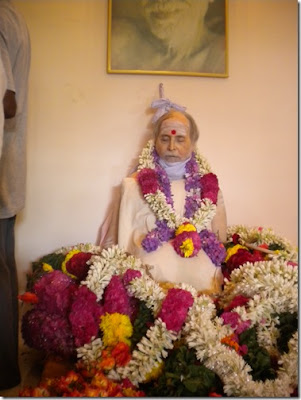
After having sat in state, as shown in photo at the beginning of this post, A. Ramana, is placed on a platform, and is anointed with a series of meaningful substances including rosewater, milk, honey, turmeric, sandalwood and ash. After each substance is poured over him, he is ritually washed with water.

hindu ceremony death corpse
Ritual washing is an important practice in Hebrew, Moslem, and Christian traditions as well. In early American times, neighbors and relatives performed this ritual. Today, for many Americans, Funeral Directors perform this task, along with embalming. Whether it takes on a religious significance or not, as a funeral director, I see it as a final act of caring for the dead. We all die. Why not take the time to bathe the dead before they are laid to rest?

funeral hindu cermony ritual memorial
Following this, he is dried and dressed in white cloths, placed in a large fabric bag, and lowered along with the platform, by ropes into the grave. Throughout the whole process, there is a great deal of chanting, incense burning, as well as participation and observation by a large group of friends and associates.

Hindu ceremony repast death corpse
The bag in which A. Ramana was placed, as well as the brick lined vault, are filled, layer by layer with holy leaves, flowers, sand, camphor and ash. Inch by inch this grave is filled with these layers of substances intended to preserve the body and express reverence and tender feelings. Throughout the process his head and body are re-adjusted to remain in the proper position.

hindu ceremony repast
At this point, his head is nearly covered, and a long piece of bamboo is used to keep track of where his head is, as it is believed that the spiritual energy of A. Ramana will flow out from his head. This is vitally important to the future construction of the temple above the vault.


Hindu ceremony burial cremationTen days later, this altar and lingam has been constructed above the vault. The following is an excerpt from Richard's blog post:

In India there are two main death ceremonies, one done on the day of the death or the day after, and then a Shradha, a ceremony where food is offered, usually occurring 10 – 14 days after the death. I suspect that one reason for this ceremony is so people who were unable to come immediately after the passing of the body are able to come and join the rites.
The Shradha consists of an elaborate pooja, with people close to the deceased playing key parts in the pooja, and then a food offering. If the Shradha is held for a villager, the food offering would be to the crows (symbolizing the spirits of ancestors). For a holy man, the food is usually offered to sadhus. This is what was done for A. Ramana. In a Shradha for a villager, the key role would be played by the person’s son. With A. Ramana, this role was played by two key people in his life in India: Jan, who runs the Tiruvannamalai AHAM ashram, and Vivian, A. Ramana’s personal attendant for the last several years.

Hindu cermony_death_funeral
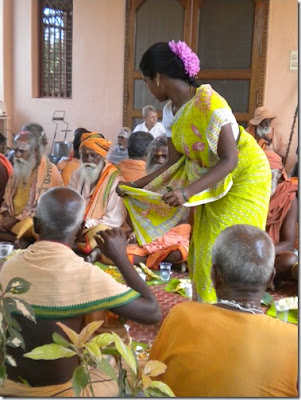
Friends and associates gather prior to the shradha.

Hindu_Cermony_Death-funeral-ritual
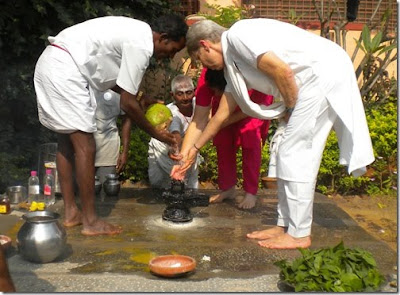
Similar to the anointment and washing of A. Raman's remains, the lingam is anointed with a series of substances and washed with water after each one. Those closest to A. Ramana are physically involved in each step. The milk, turmeric, fruit, rosewater, ash, honey, etc., and water flow through their hands and then onto the lingam, which is positioned directly above A. Ramana's head. Next, and incredible series of flower wreaths, photos and fruit are placed around the lingam.
hindu-cermony-ritual-washing
After the shradha, comes the food offering. I can't look at this photo without remembering some of the countless funeral lunches I have attended. In my community, the meal is mostly about fellowship and sharing stories. In this part of the world the emphasis is providing hospitality to others and gaining their blessings. In addition to the meal, these holy men are honored with flowers, and given clothing and money on behalf of the deceased.

hindu-cermony-funeral-repast
Following the food offering, those attending the ceremonies go their separate ways, but first, many stop to pay their respects once more.

hindu-ceremony-buddhist-death
Finally, from Richard's post, here are a few words written on the occasion of A. Ramana's death by someone close to him. I think that they speak beautifully about not just the phenomenon of death, but about our connection as humans to one another. No matter what our culture, our traditions or our spiritual perspective, in our humanity and caring for each other, we are all the same.


Everything is ended!

The wave has merged with the Ocean,


proving and assuring – once again –

that the Ocean alone exists


and that waves are part &


parcel of the Ocean!

Monday, July 9, 2012

Sarasvati's Ashes

1/13/10 
Hindu Ritual death ceremony cremation
A van, adorned with flowers carries Sarasvati and friends to the cremation grounds

It is my pleasure to share with you the experiences of Richard Clarke, a spiritual seeker and expat living in Tiruvannamalai, India. Richard writes beautifully about his experiences observing, and engaging in Indian village life. In November 2008, I shared photos from Richard's blog 'Living in the Embrace of Arunachala' documenting the preparation of a funeral vehicle. Recently, Richard wrote to me that one of his fellow seekers and expats passed away, and he wished to share his experience with the readers of The Daily Undertaker. On his blog, he has documented the experience from death, through preparations for cremation, the procession, the cremation, the gathering of cremated remains, all the rituals involved in each step, and finally the scattering of the remains. I have included photos and excerpts from his posts, and I strongly encourage you to follow the links and read the full story yourselves. There is a beauty of completeness, affirmation of life, acceptance, and generous, meaningful participation in this story, that may change your view about the rituals surrounding death. It has certainly enriched my understanding.


"In India, when this happens, events move fast. There is a most powerful tradition that the body is to be cremated that day. So I, accompanied by Rajan, our driver, the person who gave Sarasvati the most support over the last few months, had to go to the police and to government offices to properly register the death. Meanwhile, Carol, helped by other of Sarasvati’s friends, waited at her apartment to prepare the body."

Hindu Ritual death ceremony cremation
Rickshaw Drivers, strangers to the deceased, stop their work to help with the cremation rituals.


"I have to again say a few words about the rickshaw drivers. These men are thought to be “low class” by many Indians and Westerners. What we saw this day was how they stepped in and took on the role of family to Sarasvati, a Westerner with no family here. They did this readily and freely, without asking for anything. They were loving and unstinting in their care for Sarasvati on this day. I offer them my deepest thanks. "


Hindu Ritual death ceremony cremation
Taking on the role of eldest son, Richard lights the pyre

Hindu Ritual death ceremony cremation
The cremated remains are later gathered from the ashes of the pyre.
Hindu Ritual death-cremation
Scattering the remains in the river.


"I stop for a bit, to say a last farewell to the body of a friend and fellow spiritual seeker, Sarasvati.
I then look once more at the peaceful and beautiful waters here. My thought is that I too may be blessed to die with Arunachala, and maybe this is where the last remains of this body will be placed."
Now we can go home, take our morning baths and eat breakfast."

The rituals and practices described and pictured in Richard's account may seem foreign and strange to us, and many of the procedures, such as fueling the fire with tires, kerosene and cow dung, would not necessarily be acceptable in the West. However, what translates beautifully is the power of the participation of friends in the rituals surrounding death and disposition. In Richard's account we experience the fullness and completion of the necessary tasks that bring us from the experience of death, back to life. I would argue strongly that those necessary tasks include ritual just as much as disposition, and participation in each is powerfully healing for those who grieve.

For the full posts and many more photos, please visit:
and

Thursday, April 5, 2012

Future of Cremation Rituals at Risk


Kathmandu's authorities prepare to spend millions on an electric-powered crematorium to safeguard the health and safety of surrounding communities. An Indian conglomerate has won the tender, splitting local communities who fear that an ancient tradition will be lost.

Read more: http://www.smh.com.au/world/ritual-of-last-goodbye-in-kathmandu-20120405-1wff6.html#ixzz1rBAkcxqn

Wednesday, January 11, 2012

Upright Casket Created for Late Wanga King


"According to Wanga customs, kings are buried while seated, wrapped in animal skin with a stool, the symbol power, placed on their head.  Wambani’s burial will be done in the modern way but still uphold the tradition.The coffin that will be used to bury the king has been built like a chair to comply with the tradition."
for the full story, visit The Daily Nation

Friday, November 11, 2011

Silent Souls


Films that deal with the realities of death are few and far between. Those that also explore grief and funeral rituals are very rare indeed.  The 2011 release, Silent Souls does all of this in an elegant, gentle and thought provoking manner.   This compelling story about the Merja of Russia, allows us to understand some of their traditions and funerary rituals. In doing so, we are also allowed a new understanding of the human condition and of our own needs in life, grief and death.


Directed by Aleksei Fedorchenko, and based on a novel "The Buntings" by Aist Sergeyev, Silent Souls chronicles the thousand mile road trip of two friends.
When Miron’s beloved wife Tanya passes away, he asks his best friend Aist to help him say goodbye to her according to the rituals of the Merja culture, an ancient Finno-Ugric tribe from Lake Nero in West Central Russia. Although the Merja people assimilated into Russians in the17th century, their myths and traditions live on in their descendants’ modern life.


The two men set out on a road trip thousands of miles across the boundless land along with two small birds in a cage. Along the way, the funerary customs and traditional beliefs of the Merjans, are slowly revealed. In their conversations and memories, their defining relationships; Miron's with his wife Tanya, and Aist's with his deceased mother and poet father, bring life and meaning to the world view that is their ethnic heritage.


This film is remarkable in its gentle unhurried pace, and breathtaking cinematography, and in the volumes of information conveyed by the subtle actions and limited speech of its characters. Most compelling though, is the degree to which this film brings into focus the vital importance of  our participation in rituals and traditions.  Ultimately, those actions provide us with essential sustenance; giving us of our sense of self and our place in the world.


For more information about this remarkable film, visit 

Friday, September 23, 2011

Fire Festival of Remembrance

Bolas de Fuego 
Rituals and festivals take many forms.  The Bolas de Fuego Festival of Remembrance in Nejapa, El Salvador commemorates the eruption of a volcano.  Young men act out this horrifying calamity through a ritual firefight waged with gasoline soaked rags.  How does this make anyone in the town sleep easier?


Ritual can act as a form of vaccination.  We deal with a small piece of what terrifies us.  This small dose can be beaten by our defenses.  Throwing the balls ourselves gives us a sense of control over the unpredictable.  Getting hit by a flaming ball, we survive and relish the excitement.   
Does the festival prevent us from being decimated by another volcanic eruption?  Do I want this festival to take place in my neighborhood?  No and No.  However, it does provide the residents of Nejapa with a way to approach and deal with the overwhelming, and that is the powerful quality that ritual brings to our approach to the difficult and insurmountable issues that confront us in life and death.

Monday, March 22, 2010

Ching Ming: Tomb Sweeping Day

It is almost upon us again... With spring comes Ching Ming; Grave Sweeping Day in the Chinese cultural tradition. Usually falling in early April, Ching Ming is a time when families gather, often very early in the morning, and travel to the graves of their ancestors to honor and remember them.
chinese ceremony memorial art
Scrubbing an ancestor's grave stone on Ching Ming. Photo from the wonderful blog,

The graves are swept and cleaned, incense and paper objects are burned, and food and flowers are offered to the dead. The belief is that the food and paper objects are transported and transformed to meet the continuing needs of departed loved ones.

chinese ceremony death

Objects such as this paper laptop computer are burned in this world and can be used by grandfather in the next.

chinese ceremony memorial stone

In honoring our ancestors with gifts of food and flowers, we demonstrate that they are still important to us, just as we hope that our children will, in turn, remember us.

Chinese ceremony death

This custom may seem to be old fashioned superstition, and I'm sure that more than a few participants in these rituals have doubts about the burnt objects passing on to their ancestors. Similarly, some participants at Christian rituals may doubt the transformation of bread and wine into the body and blood of Jesus Christ. Most, I'm sure, believe figuratively if not literally.
Chinese ritual death ceremony

While the efficacy of these rituals may be debatable, their importance and relevance is clear to see. Gathering to honor and remember ancestors is strengthening to the family unit, a positive step through grief, and a very precious opportunity to continue a relationship, whether grandmother actually gets any of the dumplings or not.

If we think that rituals like this are wasteful or naive, we should look again at how much we miss out by ending our conversations and expressions of love with our own departed.

dying Chinese ritual ceremony funeral

The loved ones we remember are people just like we are. Their form and needs may have changed to nothing, or something we cannot begin to comprehend, but for us, in our memories, they are still Ahmah, or Granny. They still like licorice, or noodles. They still have a sparkle in their eyes, and maybe talk funny when their dentures slip. These are the things we remember and celebrate and love. So it makes emotional sense for us to honor them in a way that reminds us of them. They may not need it, but we do.

Friday, February 20, 2009

Closing, Lowering, and Giving Dirt


As an undertaker, each family I serve has different ideas about what their service should be like, and I follow their wishes.  Most often, people want something similar to what they've seen before.  There is a comfort for grieving families, whose world has turned upside down, in following familiar rituals, and despite all the buzz about personalization, I cannot emphasize enough the importance of tradition and ritual.  
Another part of my job is to suggest new things to families that, in my experience, have helped others.  I try to encourage participation in the service,  and the consideration of rituals that may be new to them.
As I have discussed in previous posts, traditions that are considered normal and appropriate in some places can seem disturbing in others.  The traditions of closing a casket in front of family members and watching the casket as it is lowered into the grave, followed by sprinkling a handful or shovel of earth into the grave,  are not as extreme to people where I work in rural Wisconsin as a sky burial or promession would be, but many here  say they couldn't bear to do any of them.
Where I used to work in Portland, Oregon, watching as the casket is closed and again, as it is lowered are regular parts of the service, and I think that they can be healthy and meaningful for grieving families.  In the Jewish tradition, among others, family and friends sprinkle the casket and grave with earth.  This is a wonderful symbolic act of participation in the burial and accepting the reality of death.  At my father's burial, I shoveled some earth into his grave, and even at the age of 8, it was a moving and cathartic experience for me.  
One of the most important things a funeral does is to allow the grieving to accept the reality of death in a safe and comforting atmosphere.  Participation in the rituals helps us to perform that last loving service for the deceased, and that in turn allows us to accept emotionally, the reality of the situation, so that we may in time move on back into life.  In our minds, we know that the person is dead, but our hearts are reluctant to accept this unpleasant fact.
Watching and helping with these tasks can be emotionally demanding, but I believe it makes the rest of the journey that much easier.  We will certainly cry when we do it, but those emotions need to be expressed and worked through, and the funeral can be the best time to do it. 

Related Posts with Thumbnails

Contact Me

My photo
Funeral service faces a crisis of relevance, and I am passionate about keeping the best traditions of service alive while adapting to the changing needs of families. Feel free to contact me with questions, or to share your thoughts on funeral service, ritual, and memorialization. dailyundertaker@gmail.com

Followers