Showing posts with label hearse. Show all posts

Thursday, January 19, 2012

Charleston mortician, car buff restores rare 1959 Cadillac hearse


Rev. Marvin Pasley, funeral director at Pasley’s Mortuary west of the Ashley, shows off a classic 1959 Cadillac hearse acquired five years ago and recently restored. The mortuary has employed the rare hearse in a few burials.

Visit the Post and Courier for the full story and more photos

Tuesday, April 27, 2010

The McLaren Minute: Remarkable in its Orthodoxy


Lennon may be everywhere, but he is also nowhere;
McLaren is at Highgate.
no funeral service
Master publicist and Punk Rock Impresario, Malcolm McLaren's funeral and its attendant 'minute of mayhem' was a milestone in the history of funeral rites. The coverage of this ritual event and the commentary that surrounded and followed it was extensive, so I won't repeat the details here, but to remind my gentle readers that Mr. McLaren's spray-painted casket was paraded through London, following services at a deconsecrated church, that mourners were transported in a festooned double decker bus to Highgate Cemetery for burial, and that Mr. McLarens' wish for a minute of mayhem in his honor was communicated by his son, and celebrated creatively by his fans.

It must certainly be said that this was a creative, expressive and remarkable funeral, but what is most striking is how closely to established tradition it clings. This is not for a lack of imagination, nor is it an accident.

no funeral service
When John Lennon, a revolutionary of a different stripe, died 30 years before McLaren shuffled off his mortal coil, a much more radical departure from tradition occurred. The public was encouraged to celebrate and mourn him wherever they happened to be, in whatever manner they chose, using whatever focal point they thought to be appropriate. Mr. Lennon's mortal remains were nowhere to be seen, and although an enormous gathering assembled in Central Park, as well as individual shrines in front of the Dakota building, none of this was endorsed, authorized or led by Mr. Lennon's family. The service was everywhere and nowhere; everything and nothing. It was a break from the constraining as well as the comforting and defining traditions of the past.

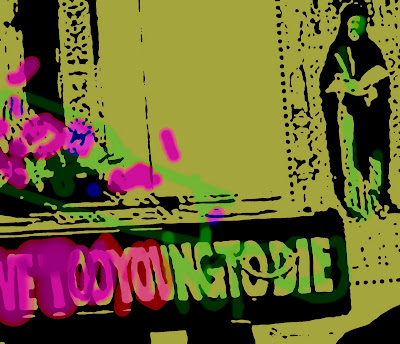
Not so with McLaren. Certainly his minute of mayhem was a departure from the traditional minute of silence, but it had much more in common that an amorphous 'do your own thing, man'. The community of the bereaved were unified and comforted in a collective act of remembrance as meaningful and powerful as any solemn or religious rite. The coffin, spray-painted with the McLaren slogan "Too Fast To Live, Too Young To Die" shouted "I'll do it MY way". McLaren's way, though, was the way of his fathers and grandfathers. Carried by an honored group of relatives and associates, he was placed in a special ceremonial vehicle, and transported in a very public manner to his permanent place of rest. In contrast, Lennon was slipped away silently and secretly in an ordinary transport vehicle by who-knows-who, privately cremated, and then off to who-knows-where, for who-knows-how long. Lennon may be everywhere, but he is also nowhere; McLaren is at Highgate.

no funeral service
A service held at a deconsecrated church has a lot more in common with a service at church, than an open invitation to do whatever you want wherever you want. Remembrances and eulogies, and a recording of Sid Vicious singing 'My Way' bring a community and a family together to remember and share the burden of loss. They do this just as effectively if they are using four letter words and a few repeated notes on an electric bass, as would communion, a homily and 'How Great Thou Art' played on the organ. In fact, all of the important elements of a meaningful funeral were present at McLaren' s service.

Just as Punk Rock needs something to be angry about, something to rebel against, something to contrast with, McLarens' funeral needed those traditional elements to riff off of, to bring what is important into focus. Let's not forget that Sid Vicious sang Frank Sinatra and Eddie Cochran. It may not have been your grandfather's music, but it wasn't the sound of one hand clapping either.

In thirty more years, McLaren's service will seem more like Queen Victoria's than John Lennon's, but I hope it doesn't seem foreign or revolutionary to us then. If our funeral traditions in thirty years don't have the timeless elements of participation, ritual, community and public acknowledgement of the loss, we will have, as the Sex Pistols lyric goes, "No Feeling".

Friday, February 6, 2009

When the Hearse Goes By

2/6/09


One of the favorite folk songs that American children learn either from their families or on the playgrounds deals with the gruesome subject of decomposition. The song's origins go back to the 19th century, at least, when it was documented among British soldiers serving in the Crimean campaign. The catchiness of the melody and the rare opportunity to speak humorously about the ugly side of death doubtlessly has ensured the ballad's survival into the 21st century. Like most folk songs, there is no definitive version. -from http://www.alsirat.com/deathlore/worms.html
This is the version I remember learning as a child, or at least, all I remember of it:

Did you ever think when a hearse goes by 
that you might be the next to die? 
They wrap you up in a dirty sheet Justify Full
and bury you down about six feet deep.
The worms crawl in and the worms crawl out 
the worms play pinochle in your snout.

This song has been a vivid reminder of the reality of death to many generations of children.  A gooey, creepy picture of death to be sure, but certainly one that a child can relate to and find interesting.   The hearse is indeed a reminder to us all that we may be the next to die.  As the person driving the hearse, I feel the discomfort of many who look upon, and try not to look upon the scene.  Sometimes a friend is driving in the opposite direction and tries to figure out in an instant if it's alright to wave to me or not.  Sometimes the postman will stop and take off his cap. Certainly everyone notices the hearse, and although most pretend not to notice, I bet quite a few picture the worms playing cards.

The hearse doesn't roll through town as often as it used to.  More and more of us are choosing services that deal less and less with the reality of death, and more with the life that was lived.  It is a good thing that we celebrate life, but I think that communities of humans need that reminder that one of them has died, and remember to celebrate life while it's here, because one of us will certainly be next. 

Wednesday, November 12, 2008

Indian Village Funeral Car

As I wrote in my post on funeral processions, you don't need a Cadillac or Lincoln Hearse for a proper funeral procession. What is important is that the vehicle is special and chosen for a reason. This vehicle being prepared to transport a beloved South Indian Village woman to her cremation certainly qualifies.

After the wood frame is built and attached to the car, bamboo sticks covered with flowers are bent and inserted into the frame.


http://richardarunachala.wordpress.com/2008/10/30/south-india-village-funeral/


Finally, the vehicle is complete and ready to transport this woman ceremoniously to the place of her cremation- Beautiful!
-the photos and information used in this post come from a very intersting blog on South Indian Village Life. For more information on this funeral visit the blog at http://richardarunachala.wordpress.com/2008/10/30/south-india-village-funeral/

Sunday, August 31, 2008

The Procession - How Important Is It Really?

http://www.archaeologicalservices.on.ca/featured.htm
http://www.judybaca.com/dia/text/images/funeral%20procession

http://www.bensware.com/firetrucks/bedfordFuneralProcession.jpg


Do you realize how much time, effort and money go into a funeral procession? A new Cadillac Hearse costs about one hundred thousand dollars, it needs regular upkeep, and must be replaced regularly (anyone who has ever experienced car trouble during a funeral procession can attest to the importance of reliable equipment.) Gas prices aren't going any lower, and personally, I've spent weeks of my life standing out in the sun, rain and snow, flaging, and lining up cars for processions. Then, there's the inconvenience to others. In Wisconsin, processions have a maximum speed of 45 miles per hour, and though you still see some respectful people stopping or taking off their hats as a procession comes by, more often there's honking or dangerous passing from those who feel that they shouldn't be slowed down by someone else's death.
So why do we bother?
The word funeral actually comes from the latin word for torchlight procession, the traditional ancient rite, the main event, the respectful and cermonious transport of a person to their place of rest. This is the final journey, the last walk a family takes with their loved one, the 'second line' of the Jazz funeral, and it is both symbolic and healing. The procession is a public expression and enactment of the love, respect, loss of a loved one that allows both family and friends to participate. It is an opportunity for the residents of a town to witness this expression of love and respect. The procession says :
This person was important to us.
This day is not like other days.
This journey is not like other journeys.
Our loss is meaningful enough that we take special care in a
special vehicle to solemnly and ceremoniously convey the earthly remains of our
loved one to a special place where their life will be honored and remembered.
At ground zero after 9/11, whenever a part of one of the victims bodies was found, all work stopped, and even if it as the tiniest part of someone's remains, a hearse and escort slowly drove out as all present stood at attention in respectful silence. This is the standard of conduct that should be followed in respect for the passing of any life.
Why a hearse? For many, a Cadillac or Lincoln hearse feels to be the appropriate vehicle to convey the respect on solemnity of the occasion, but this isn't so for everyone. The important thing is that the vehicle is appropriate and intentional. I have witnessed and encouraged processions where the deceased was carried by horse drawn wagon, in a loved truck, in a special motorcycle hearse or on foot, and where cremated remains were carried in a favorite sports car, or by bicycle. I have led proccessions with fire trucks, police cars, motorcycles, an hot rods following, and these were perhaps the most poingnant and meaningful and respectful of all.
A funeral procession is one of the most meaningful and beautiful parts of a funeral service, and it's actually one of the least expensive. Why go to all the bother? Isn't that person important enough, whoever they are, that everyone can slow down a bit and drive slowly with their lights on for their final ride through town?


Related Posts with Thumbnails

Contact Me

My photo
Funeral service faces a crisis of relevance, and I am passionate about keeping the best traditions of service alive while adapting to the changing needs of families. Feel free to contact me with questions, or to share your thoughts on funeral service, ritual, and memorialization. dailyundertaker@gmail.com

Followers