Showing posts with label natural burial. Show all posts

Sunday, September 12, 2010

Finding Green Graves: Interview with Stephen Laing, Director of ASSETtrac

natural burial green
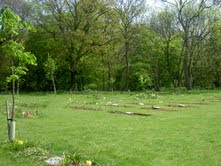
Clayton Wood Natural Cemetery


One of the common regulations at the increasingly popular green cemeteries is some form of restriction limiting the type of markers and memorials used to identify where the remains lie.  Some cemeteries allow for plantings or natural stone cairns, others prohibit any type of identifying markers.  This kind of regulation is certainly understandable in a site created with the express intent of conserving the natural appearance and functions of a burial ground.
However, these regulations can run at cross purposes with a very natural emotional needs to commune with the deceased at the place of their rest, and the desire for other loved ones or family members to be buried together.
Even at traditional cemeteries there is often less certainty about exactly where a person is buried than families might feel comfortable with.     


green cemetery tracking
ASSETtrac is a UK firm that is offering some solutions to these problems.  The firm provides microchip transponders for cemetery use.  These devices are placed below ground to provide positive identification for interments and memorial plaques and plantings.  In addition to microchip devices, Assettrac also maintains a searchable and editable database,  www.bereavement-services.org, of all major burial and cremation authorities, including all natural burial grounds in public or private management within the UK.  Stephen Laing, director of Assettrac, has graciously agreed to share a conversation about his firm and the future of cemeteries with The Daily Undertaker.

Stephen Laing

Patrick McNally: Mr. Laing, could you explain for us how your firm got into the business of providing microchip devices to cemeteries?


Stephen Laing: As a company specializing in asset identification, tracking, and software management we were approached by The Natural Burial Company who wanted to mark their plots with a device that was unseen, provided a unique grave ID, maintenance free, low cost, and indefinite life span.

PM: In the past, cemeteries have had to rely on the diligence and accuracy of the sexton’s records, which could vary widely.  If cemeteries move to your system, won’t they still be at the mercy of the person who enters the information on the chip and whether it is placed in the correct spot?  How can cemeteries and families ensure that the information is correct?

SL: The microchip we recommend is read only, so it only has a single unalterable ID number. The grave peg with its embedded chip has accompanying adhesive barcode labels for use on office wall maps, or sticking into burial registers and client correspondence if desired to minimize writing and mistakes. The chip number is printed on each label so it can be keyed into a computerized register or actually scanned in to the PC via a cable link. We do recommend a ‘standard’ position for implantation, one foot above the ‘head’ end and under 4 inches of undisturbed earth for maximum stability. Once in place each peg is scanned and checked again against the number recorded for that deceased. As with any ‘asset’ numbering system, a certain amount of care must be taken, but we hope to have minimized the chances of error. With computer based administration synchronized with a Smart phone or PDA it is now possible to take your burial register out on site electronically, and having scanned the relevant peg in the grave, display all the deceased details on screen via a wireless Bluetooth connection. This is very similar to the Memory Medallion service for vertical memorials now being offered in your country.        


green burial natural cemetery
Herongate Wood Natural Cemetery

PM: If a cemetery makes use of this tool, can it be offered to families for previous interments?  Are any of your clients applying this technology to all their interments?

SL: We have always supplied the system on a whole site basis, to reassure the operator for any grave that they’re in the right place for additional interments in a family plot or if required, to exhume someone. So they ‘chip’ every grave as a kind of insurance policy! Some do it for advance reservations too. We have never offered it to families direct.

PM: What assurance is there that this technology will A) continue to function 100+ years fro now, and B) Be accessible to the tech platforms of even 10 years from now?

SL: A) Placed underground where temperatures remain relatively stable, there is little to disturb the microchip being encapsulated in a hard non-biodegradable PVC rod. Also it requires no battery or maintenance, taking its power for a millisecond from the scanner when in range. This type of device has been in use for pet identification for over 30 years, and it’s reasonable to assume that the need to interrogate the chip even 50 years on is rather unlikely. B) We chose the animal ID technology because many families know it from their own experience, and also because many national governments have recognized the ISO standard on which it’s based. So we can reassure users both of continuity of supply and decoding technology as the hardware is being used all round the world. Bear in mind that this is an ID system not a locating system. We do encourage reliance on site knowledge, paper or computerized maps, laser positioning, GPS, even measurements from fixed points, which all help to get close to the right spot, and the scan is just for final confirmation. 

green burial tracking device
Glass-enclosed microchip
EPITRACE – The technology
 The technology is known as radio frequency identification or RFID. A practical system comprises three elements, the identification placed on or near the ‘asset’, a reader often hand held, and a register, spreadsheet, or specialist computer program.

Microchip transponder-The peg contains a passive read only microchip transponder, just a larger version of the type injected into domestic pets for proof of ownership. The operating frequency complies with a widely adopted international standard for animal ID, and approved by many governments.   

Each microchip has a unique code number, just like a barcode, and ‘locked’ inside the circuitry. It is usually supplied with barcode labels (see picture) to assist mapping and record keeping, see below. Being glass encapsulated it is embedded into a solid PVC rod for easy handling and improved strength, for resistance to any impact by spade or site machinery.
 Microchip Scanner- There are many types reading a variety of frequencies, but this one was chosen for ease of use, being one button operation and a standard 9 volt battery.
 By pressing the scan button on the battery powered reader a low strength magnetic field is created around its antenna. This field is registered by the transponder or microchip which in turn transmits its unique identity code back to the reader and displayed on the LCD screen all within a few milliseconds, together with an audible ping. The ‘read’ distance is governed by both the power output of the reader and antenna of the chip. Unlike barcode technology line of sight is not needed as any material except metallic barriers can be placed between chip and reader.  


green burial natural cemetery tracking
Clayton Wood


PM: Can the transponder be read by visitors without proprietary software on their mobile phone or pda?

SL: As RFID or microchip readers are being hard wired into some mobile phones already, I foresee families being able to look up the deceased details online provided the read range is long enough and the correct frequency is built in. However, it might be more practical if the burial ground owner supplies the service through a joint grave visit to start with or perhaps lends the equipment to the visitor even at a small charge until growth of natural burials and consequent visits and scanning frequency justifies more personal purchases. With a modern pole reader, a bit like a baseball bat, you don’t even need to bend down to the grass, and it would be quite exciting to imagine visitors wandering around a natural site picking up details of the deceased wherever they go!     

PM: Is there any add-on functionality to these transponders?  For example, could they point a visitor to a website or another source of richer information in the way that a QR code is being used in cemetery monuments? 

SL: As mentioned above, the devices are passive read only, and although some RFID chips can have data stored on them for later viewing, our feeling is that ease of use in a bereavement context is very important. Anyway the unique number can always be linked with a lot more information stored on PC, PDA, and the web, so access to data is maintained and probably cheaper. You need training to operate ‘read write’ chips.  

PM: What kind of feedback have you had from the natural cemeteries?  Is the insertion of a metal device into the ground seen by any as conflicting with the spirit of the cemetery?

SL: We have supplied the Epitrace system to over 60 sites in UK and Australia now and none have been concerned about the implantation as it doesn’t affect the visual aspect of the scenery which for many is very important. All recognize that anything ‘non-biodegradeable’ conflicts with the natural cycle of life and death and decay, however there wouldn’t be much point in having a peg that degraded or dropped out of range. I should add that only a tiny fraction of the chip itself is metal and it cannot be scanned through a metal barrier such as a bronze flat marker. It can be scanned through any other material. Many clients only permit a degradable natural stone or wooden flat marker near the grave and it is a simple matter to place the peg in the earth under the marker. Any disturbance or vandalism can help to replace a marker or a new one exactly where it was before over Uncle Fred, or his cremated remains, and family anxiety is reduced. You can imagine that these chips in different formats are also used to confirm ownership or leases of rose bushes and memorial trees, and for security purposes located in park furniture and other property to deter theft and prove ownership. We have even been approached by government agencies to investigate tagging body bags to assist identification and exhumation from mass trench burials if such a disposal system had to be used in the event of a pandemic like bird flu.   


green burial natural cemetery microchip
Herongate Wood

PM: What does the public have to gain from the introduction and adoption of this kind of tool?  Will we be able to make fuller use of the cemeteries we have?  Will we rest easier knowing where our loved ones are resting?

SL: The system was introduced to ensure that operators’ reputations were not harmed by any mis-identification of graves. There is already much debate over how visitors perceive the natural burial ground, -as a whole landscape for communing with nature or one’s faith or just a small part of it for visiting a loved one. It’s all these of course and as long as owners permit graveside visits and as long as families feel a need to associate with a marked or unmarked spot then the grave peg can lie unseen until it’s needed and reassure families that they are as close to Uncle Fred as they can get.

PM: What do you see in the future for cemeteries?  Will they adapt to the changing needs of society?

SL: It seems to me that we should encourage not just the bereaved, heritage researchers and genealogists into our traditional cemeteries but also the young and their teachers to look at headstones and increase their knowledge of local history, and become more comfortable with death than their forebears. Also being more tech- savvy they will use modern tools to counter the effects of decaying monumental inscriptions with databases and mobile accessibility. Cemetery owners I believe will recognize the value of actively marketing a wider range of services, long overdue in the public sector. For many the choice over final disposal will always be cremation or traditional burial with all the associated energy costs and harm to the planet. Ashes shot into space, lowered to reefs on the sea bed, and converted to diamonds, paintings, paper weights and jewelry have in the last decade provided surprising alternatives to the cliff top scattering. With over 200 natural burial grounds the UK is leading the ‘green burial’ movement. This third way (and there are more choices coming out of research labs) is in response to the next of kin wanting more time on the day, more choice over the ceremony and celebrant, and beautiful landscape compared with crowded urban cemeteries as well as a visible sign of their green credentials. The willingness to discuss and plan for death is getting easier and from that I see last resting places becoming destinations for enjoyment not just ceremony and duty. Are you really being disrespectful to the dead as you raise a glass from the picnic hamper?

Some years ago Penny, a natural burial owner and I were being interviewed by the BBC, and in response to a question about the graveside formalities she said ‘I don’t mind if they dance naked round the grave and fire champagne corks into it, -as long as they don’t disturb the horses’! 

PM: Thank you for sharing your thoughts and work, Stephen.

For more information about ASSETtrac:

ASSETtrac Ltd The White House, 
Oakendene Industrial Estate, Bolney Road, Cowfold 
West Sussex United Kingdom RH13 8AZ 
Tel +44 (0)1403 860063 
or visit the website


For more posts on natural and sustainable options, click here

Wednesday, July 21, 2010

The Shrouds of Kinkaraco: A Conversation with Esmerelda Kent

burial green
Named after Tibetan Buddhist Deities, Kinkara, special protectors of the Charnal Grounds, KINKARACOรค Green Burial Products produces biodegradable burial shrouds, cremation shrouds, and other ceremonial funeral products. Founded in 2005 by Esmerelda Kent, the company is 'devoted to the sacred in preserving our Earth's natural resources'. Ms. Kent has graciously agreed to share a conversation with The Daily Undertaker.
greens funeral shroud
Esmerelda Kent
Business Week 2008 photo by Eric Millette

Pat McNally: You advocate for survivors to take a greater role in participating in the physical and symbolic tasks of bringing their loved ones to their places of rest. Obviously a shroud is different from a casket in many ways, but what is the difference experientially between placing, carrying and burying a person in a shroud rather than a casket or coffin?

Esmerelda Kent: A shroud is soft and shows the actual outline of the human form unlike a casket. You are never unaware of what is taking place and that the shroud contains a human body. This “awareness” keeps the experience more authentic, spiritually conscious and real which some people want.
Our shrouds are sometimes used by the family to prepare a body and then to remove the body from the home. In some cases the families participate in the actual washing (with our KINKARACO Green BurialWashรค and shrouding the loved one there at home and have the funeral director pick the body up after a home service.
However in most cases the funeral home washes and shrouds the body . Most actual green burials do not have viewings. The ceremony takes place graveside often with the family participating in the lowering and covering of the grave. The shrouds have handles for carrying and straps for lowering when used alone without a casket that are unfurled slowly to place the shroud in the grave.

Pat McNally: There is long history of shrouds in many traditions, as you point out on your website. These shrouds were generally long strips of cloth, wound around the deceased.
The design of your shrouds is more complex. Would you explain the ideas behind the features incorporated into your designs?

Esmerelda Kent: With shrouds not being a traditional part of burial practice in America the latter half of the 20th Century, wrapping a shroud is unfamiliar to most funeral homes outside of the Muslim or Jewish Faith. When I began working in a green cemetery in 2004 we first used blankets, quilts and cloths given to us by the family to act as “shrouds” or long yardage of biodegradable natural fabric. They looked unattractive and were very difficult to lower into a grave on casket straps so we often had to hand the body down into the grave with the help of grounds crew. Our shroud design actually came to me “in the field” so to speak from this experience that incorporated all I knew was needed –the lowering straps attached to the shroud with a wooden “spine” sewn into the back for more stability as well as handles for lifting and carrying. This is what we call the Endfinity รคlowering device or Back #1 for green burial without a casket. Back #2 has no straps or wood, just natural woven handles for cremation or placement inside of a casket . The shrouds replace clothing and are so much easier than dressing corpses in street clothes.

Other features include Herbal linings of Lavender, Rose petals or White Sage.

The shroud of Jesus Christ contained the herbal substances of Myrrh resin and Aloes wood .

We also offer the Heart Pocketรคwhich is a pocket on the face cloth piece that rests on the heart and holds prayers, photos, poems, etc. for both burial and cremation.

Home Funeral shroud

The VERSAILLES silk shroud from the MORT COUTURE tm collection

Pat McNally: There are a lot of products in the marketplace these days for people interested in more natural funeral services, but many consumers may not be aware of all their options. What can funeral directors, craftspeople and other providers do to make families aware of their options without overwhelming them with the sheer volume of possibilities.

Esmerelda Kent: The first thing a funeral home can do is eliminate unpractical unnecessary gimmicky products that are conceived by people who have never done funeral service and that would never work in a funeral home setting. I saw a “coffin” recently shaped like an egg for people to be buried in the fetal position. When I explained that the person would have to be practically hog tied at the moment of death to fit in it they understood that good industrial design has to serve function.
At the same time one of the biggest mistakes in my opinion that funeral homes have been making after the initial recession in 2009 is gathering information about new products and waiting until a family comes in asking for it without investing in new products.

Our products are new. People are not going to ask for them. They need to see, feel and smell them! A picture and vague description will not sell new products. There is a complacency to change, fear of spending money and an arrogance, that as we all know many funeral homes now regret having initially ignored the cremation demand and the slow industry response to that phenomena. Offering green options is the same thing. Funeral homes need to be pro-active. They need to support PRACTICAL sustainable products. Many feel importing caskets from China and Europe is hardly “green” coming across oceans, across the country on trucks, and find nice woodworkers locally to build fine simple caskets. Others don’t care.

Funeral homes who want to promote green options need to commit to new “green” products and carry them in stock. Our solution is providing a simple Intro Pac containing 1 burial shroud, 1 cremation shroud, 2 bottles of Green Burial Wash and a LOOK BOOK. Funeral homes that purchase this package do much better than those who keep information about our products “on file”.

eco eco color shroud

A Kinkaraco Shroud used on HBO's Six Feet Under, 2005

Pat McNally: What kind of relationships do you have with funeral service providers, and how do you think these relationships can improve to better serve families?

Esmerelda Kent: I have to say I love our funeral homes. I take a lot of time responding to every inquiry we receive on the internet from the funeral homes and make sure they understand the value of our products. Often there is a young (often female) “internal champion” in the funeral home who convinces the owner to provide these new products. It is one of the joys of my life that I am able to be “in touch” with so many states across the country selling these products.

There are so many smart, funny, kind and wonderful funeral directors out there. I vouch for my funeral homes. It is part of our business model to stimulate local American business so when individual customers get in touch with us online we inform them of the nearest funeral home reseller of our products and send them to our friends there. That way we keep an ongoing relationship with the funeral home and the customer can go see and feel the products in person and meet our friend the funeral director.

ashes garden cremation shroud

The 'PURELIGHT' Shroud

Pat McNally: Your web site provides a list of green cemeteries throughout the country. Many parts of the country are not currently served by a green cemetery, and those interested in a green burial may be understandably reluctant to bury out of their area. Do you have any advice for people in this situation?

Esmerelda Kent: First off let me explain that all of our products are green but they can be used for any type of funeral service- not just green burial but burial within a casket, cremation and removal from home and hospital. Believe it or not people have purchased herbal shrouds and put their embalmed relatives in them inside metal caskets in traditional cemeteries!

What people do with our products is none of my business.

That said, many new green areas are opening up in traditional cemeteries around the country everyday. I can’t keep up with it and there are at least twice as many green cemeteries now than are reflected on our website.

Many small cemeteries do not require vaults. Many traditional cemeteries will let you place a cement vault upside down over the shrouded body touching the earth or just a liner with no top or bottom. Many people are turning acreage into green cemeteries and people call me about how to do this regularly. This is a state by state issue of course and the Green Burial Council and Memorial Ecosystems are the most experienced in how to do this.

This is consumer driven. Where there is a will there is a way.

Ask for what you want and don’t take “NO” for an answer!

Pat McNally: Some in the funeral industry claim that green options are something that generates a lot of press and interest, but are seldom actually selected by families. How would you respond to this thought?

Esmerelda Kent: I think the funeral industry’s expectations are too high. I think some funeral homes are looking for a savior to get them back to the “good ol’ days” of huge profits.

Green burial is not going to save the funeral industry.
It’s going to bring the funeral industry into the sustainable 21st century.

The press regarding Green Burial began back in 2000. The funeral industry didn’t take note ‘til 2008 and become interested in earnest for the most part until 2009.

This is new. It takes time.

I see green burial as secular people having the same options as Muslim families or Jewish families. People who have lived natural lives, eating organic food deserve to be “composted” if they so desire. This is just another option. It is not the big solution. It is a more common sense solution that more and more baby boomers will choose along with ever growing cremation.

Pat McNally: Your site encourages and gives advice on ceremonial washing of the deceased. This is another practice that has a long history in most if not all cultures. What do we have to gain from returning to this practice?

Esmerelda Kent: It is beautiful. It is ceremonial. It is spiritual. It is ablution. It is non-invasive and it smells nice! The family often gets involved with this process when loved ones pass away at home in hospice. It is a great ceremony of care and closure. It is intuitively female in nature.

green cemetary home funeral eco org

The 'AFRICAN MUDCLOTH ' Shroud

Pat McNally: Many in funeral service, even those who advocate for increased family participation, dismiss home funeral ideas, saying that American families just cannot handle the realities of dealing hands on with the dead. We are told that viewing the body is an important step in accepting the reality of death, but that the reality of actually moving, or caring for our dead is too much for us. What are your thoughts on survivors addressing the physical realities of death?

Esmerelda Kent: I personally chose to have both my children at home in the bedroom.
In order to do this my husband and I studied and did extensive preparation and were completely aware of the reality of what we were in for.

Home childbirth is certainly not for everyone just as home funerals are not for everyone. Birth and Death are the most intense human experiences we have. It’s messy.

I have seen people get in way over their heads when a “Home Funeral” is more of an intellectual theory and political exercise and they do not have proper professionally trained help.

I have personally sold shrouds to people where they were not prepared and things did not go well. This is a great frustration to myself and funeral directors involved.

Home funerals are amazingly meaningful rich experiences when people are prepared and they are done right.

I am constantly advocating for funeral homes to offer a “Home Funeral Package” or “Ala Carte home funeral services” such as listing charges for just transportation, just filing paperwork, etc. Many people would like the help if they thought the funeral director would do just what they need help with. Not everyone wants to drive Mom to the cemetery in the back of the SUV!

The biggest thing right now is for funeral homes to be HUMBLE and do whatever people want that’s legal. Add more options, be flexible and most of all listen & learn from your customers.

home death new funeral rememberance service

The 'Varanasi' Shroud

Pat McNally: What effect would you hope that your work and products would have on the ways we think about and participate in caring for our dead?

Esmerelda Kent: Families have said to me:

” Your shrouds are like wedding gowns!”

“Your shroud turned the tragedy of my brother’s death into something sacred.”

“When my daughter died of breast cancer at 39 and I wrapped her in your shroud I felt she was protected.”

It is my personal desire to be of some small service to humankind while I am living.

I believe in ceremony and in honoring the life of a human being. Nothing is more tragic to me than a direct burial or cremation with no one in attendance.

KINKARACOรคgreen burial products exists to help offer 100% natural ,beautiful, caring, spiritually conceived ancient and sacred products to families to be able to participate in the death of loved ones. At the same time we are offering NEW, easy to use, simple (it is our goal to replace dressing corpses!) low cost , attractive funeral products for funeral homes that take up very little space.

So far it has been a positive meaningful experience for myself, the families , and the funeral homes and I am very grateful.

Pat McNally: Thank you so much for sharing your thoughts with us!

For more information on Kinkaraco shrouds and other products, as well as some "how-to"s and information on the history of shrouds, please visit the Kinkaraco website, and the April 2008 American Cemetery article .

Tuesday, November 11, 2008

Natural Burials in South Australia


South Australia has joined NSW, Victoria and Tasmania in offering a site for natural burials.
Urban Development Minister Paul Holloway said the state's first natural burial ground would be established at Enfield Memorial Park in Adelaide's northern suburbs later this year.
It allows for bodies to be prepared without chemical preservatives and then buried in a biodegradable casket or a shroud.
The grave is marked with a native tree or shrub rather than a headstone or monument.
"Over time the bushland created by the new burial ground will become a living and lasting natural memorial," Mr Holloway Natural burials were first introduced in the United Kingdom in the early 1990s.
-from The Age .Com http://news.theage.com.au/national/south-australia-to-offer-natural-burials-20081022-5663.html

Thursday, July 24, 2008

The Shrouds of Kinkaraco: A Conversation With Esmerelda Kent

Named after Tibetan Buddhist Deities, Kinkara, special protectors of the Charnal Grounds,KINKARACOรค Green Burial Products produces biodegradable burial shrouds, cremation shrouds, and other ceremonial funeral products. Founded in 2005 by Esmerelda Kent, the company is 'devoted to the sacred in preserving our Earth's natural resources'. Ms. Kent has graciously agreed to share a conversation with The Daily Undertaker.

Esmerelda Kent
Business Week 2008 photo by Eric Millette

Pat McNally: You advocate for survivors to take a greater role in participating in the physical and symbolic tasks of bringing their loved ones to their places of rest. Obviously a shroud is different from a casket in many ways, but what is the difference experientially between placing, carrying and burying a person in a shroud rather than a casket or coffin?

Esmerelda Kent: A shroud is soft and shows the actual outline of the human form unlike a casket. You are never unaware of what is taking place and that the shroud contains a human body. This “awareness” keeps the experience more authentic, spiritually conscious and real which some people want.
Our shrouds are sometimes used by the family to prepare a body and then to remove the body from the home. In some cases the families participate in the actual washing (with our KINKARACO Green BurialWashรค and shrouding the loved one there at home and have the funeral director pick the body up after a home service.
However in most cases the funeral home washes and shrouds the body . Most actual green burials do not have viewings. The ceremony takes place graveside often with the family participating in the lowering and covering of the grave. The shrouds have handles for carrying and straps for lowering when used alone without a casket that are unfurled slowly to place the shroud in the grave.

Pat McNally: There is long history of shrouds in many traditions, as you point out on your website. These shrouds were generally long strips of cloth, wound around the deceased.
The design of your shrouds is more complex. Would you explain the ideas behind the features incorporated into your designs?

Esmerelda Kent: With shrouds not being a traditional part of burial practice in America the latter half of the 20th Century, wrapping a shroud is unfamiliar to most funeral homes outside of the Muslim or Jewish Faith. When I began working in a green cemetery in 2004 we first used blankets, quilts and cloths given to us by the family to act as “shrouds” or long yardage of biodegradable natural fabric. They looked unattractive and were very difficult to lower into a grave on casket straps so we often had to hand the body down into the grave with the help of grounds crew. Our shroud design actually came to me “in the field” so to speak from this experience that incorporated all I knew was needed –the lowering straps attached to the shroud with a wooden “spine” sewn into the back for more stability as well as handles for lifting and carrying. This is what we call the Endfinity รคlowering device or Back #1 for green burial without a casket. Back #2 has no straps or wood, just natural woven handles for cremation or placement inside of a casket . The shrouds replace clothing and are so much easier than dressing corpses in street clothes.

Other features include Herbal linings of Lavender, Rose petals or White Sage.

The shroud of Jesus Christ contained the herbal substances of Myrrh resin and Aloes wood .

We also offer the Heart Pocketรคwhich is a pocket on the face cloth piece that rests on the heart and holds prayers, photos, poems, etc. for both burial and cremation.

The VERSAILLES silk shroud from the MORT COUTURE tm collection

Pat McNally: There are a lot of products in the marketplace these days for people interested in more natural funeral services, but many consumers may not be aware of all their options. What can funeral directors, craftspeople and other providers do to make families aware of their options without overwhelming them with the sheer volume of possibilities.

Esmerelda Kent: The first thing a funeral home can do is eliminate unpractical unnecessary gimmicky products that are conceived by people who have never done funeral service and that would never work in a funeral home setting. I saw a “coffin” recently shaped like an egg for people to be buried in the fetal position. When I explained that the person would have to be practically hog tied at the moment of death to fit in it they understood that good industrial design has to serve function.
At the same time one of the biggest mistakes in my opinion that funeral homes have been making after the initial recession in 2009 is gathering information about new products and waiting until a family comes in asking for it without investing in new products.

Our products are new. People are not going to ask for them. They need to see, feel and smell them! A picture and vague description will not sell new products. There is a complacency to change, fear of spending money and an arrogance, that as we all know many funeral homes now regret having initially ignored the cremation demand and the slow industry response to that phenomena. Offering green options is the same thing. Funeral homes need to be pro-active. They need to support PRACTICAL sustainable products. Many feel importing caskets fromChina and Europe is hardly “green” coming across oceans, across the country on trucks, and find nice woodworkers locally to build fine simple caskets. Others don’t care.

Funeral homes who want to promote green options need to commit to new “green” products and carry them in stock. Our solution is providing a simple Intro Pac containing 1 burial shroud, 1 cremation shroud, 2 bottles of Green Burial Wash and a LOOK BOOK. Funeral homes that purchase this package do much better than those who keep information about our products “on file”.

A Kinkaraco Shroud used on HBO's Six Feet Under, 2005

Pat McNally: What kind of relationships do you have with funeral service providers, and how do you think these relationships can improve to better serve families?

Esmerelda Kent: I have to say I love our funeral homes. I take a lot of time responding to every inquiry we receive on the internet from the funeral homes and make sure they understand the value of our products. Often there is a young (often female) “internal champion” in the funeral home who convinces the owner to provide these new products. It is one of the joys of my life that I am able to be “in touch” with so many states across the country selling these products.

There are so many smart, funny, kind and wonderful funeral directors out there. I vouch for my funeral homes. It is part of our business model to stimulate local American business so when individual customers get in touch with us online we inform them of the nearest funeral home reseller of our products and send them to our friends there. That way we keep an ongoing relationship with the funeral home and the customer can go see and feel the products in person and meet our friend the funeral director.

The 'PURELIGHT' Shroud

Pat McNally: Your web site provides a list of green cemeteries throughout the country. Many parts of the country are not currently served by a green cemetery, and those interested in a green burial may be understandably reluctant to bury out of their area. Do you have any advice for people in this situation?

Esmerelda Kent: First off let me explain that all of our products are green but they can be used for any type of funeral service- not just green burial but burial within a casket, cremation and removal from home and hospital. Believe it or not people have purchased herbal shrouds and put their embalmed relatives in them inside metal caskets in traditional cemeteries!

What people do with our products is none of my business.

That said, many new green areas are opening up in traditional cemeteries around the country everyday. I can’t keep up with it and there are at least twice as many green cemeteries now than are reflected on our website.

Many small cemeteries do not require vaults. Many traditional cemeteries will let you place a cement vault upside down over the shrouded body touching the earth or just a liner with no top or bottom. Many people are turning acreage into green cemeteries and people call me about how to do this regularly. This is a state by state issue of course and the Green Burial Council and Memorial Ecosystems are the most experienced in how to do this.

This is consumer driven. Where there is a will there is a way.

Ask for what you want and don’t take “NO” for an answer!

Pat McNally: Some in the funeral industry claim that green options are something that generates a lot of press and interest, but are seldom actually selected by families. How would you respond to this thought?

Esmerelda Kent: I think the funeral industry’s expectations are too high. I think some funeral homes are looking for a savior to get them back to the “good ol’ days” of huge profits.

Green burial is not going to save the funeral industry.
It’s going to bring the funeral industry into the sustainable 21st century.

The press regarding Green Burial began back in 2000. The funeral industry didn’t take note ‘til 2008 and become interested in earnest for the most part until 2009.

This is new. It takes time.

I see green burial as secular people having the same options as Muslim families or Jewish families. People who have lived natural lives, eating organic food deserve to be “composted” if they so desire. This is just another option. It is not the big solution. It is a more common sense solution that more and more baby boomers will choose along with ever growing cremation.

Pat McNally: Your site encourages and gives advice on ceremonial washing of the deceased. This is another practice that has a long history in most if not all cultures. What do we have to gain from returning to this practice?

Esmerelda Kent: It is beautiful. It is ceremonial. It is spiritual. It is ablution. It is non-invasive and it smells nice! The family often gets involved with this process when loved ones pass away at home in hospice. It is a great ceremony of care and closure. It is intuitively female in nature.

The 'AFRICAN MUDCLOTH ' Shroud

Pat McNally: Many in funeral service, even those who advocate for increased family participation, dismiss home funeral ideas, saying that American families just cannot handle the realities of dealing hands on with the dead. We are told that viewing the body is an important step in accepting the reality of death, but that the reality of actually moving, or caring for our dead is too much for us. What are your thoughts on survivors addressing the physical realities of death?

Esmerelda Kent: I personally chose to have both my children at home in the bedroom.
In order to do this my husband and I studied and did extensive preparation and were completely aware of the reality of what we were in for.

Home childbirth is certainly not for everyone just as home funerals are not for everyone. Birth and Death are the most intense human experiences we have. It’s messy.

I have seen people get in way over their heads when a “Home Funeral” is more of an intellectual theory and political exercise and they do not have proper professionally trained help.

I have personally sold shrouds to people where they were not prepared and things did not go well. This is a great frustration to myself and funeral directors involved.

Home funerals are amazingly meaningful rich experiences when people are prepared and they are done right.

I am constantly advocating for funeral homes to offer a “Home Funeral Package” or “Ala Carte home funeral services” such as listing charges for just transportation, just filing paperwork, etc. Many people would like the help if they thought the funeral director would do just what they need help with. Not everyone wants to drive Mom to the cemetery in the back of the SUV!

The biggest thing right now is for funeral homes to be HUMBLE and do whatever people want that’s legal. Add more options, be flexible and most of all listen & learn from your customers.

The 'Varanasi' Shroud

Pat McNally: What effect would you hope that your work and products would have on the ways we think about and participate in caring for our dead?

Esmerelda Kent: Families have said to me:

” Your shrouds are like wedding gowns!”

“Your shroud turned the tragedy of my brother’s death into something sacred.”

“When my daughter died of breast cancer at 39 and I wrapped her in your shroud I felt she was protected.”

It is my personal desire to be of some small service to humankind while I am living.

I believe in ceremony and in honoring the life of a human being. Nothing is more tragic to me than a direct burial or cremation with no one in attendance.

KINKARACOรคgreen burial products exists to help offer 100% natural ,beautiful, caring, spiritually conceived ancient and sacred products to families to be able to participate in the death of loved ones. At the same time we are offering NEW, easy to use, simple (it is our goal to replace dressing corpses!) low cost , attractive funeral products for funeral homes that take up very little space.

So far it has been a positive meaningful experience for myself, the families , and the funeral homes and I am very grateful.

Pat McNally: Thank you so much for sharing your thoughts with us!

For more information on Kinkaraco shrouds and other products, as well as some "how-to"s and information on the history of shrouds, please visit the Kinkaraco website, and the April 2008 American Cemetery article .

Related Posts with Thumbnails

Contact Me

My photo
Funeral service faces a crisis of relevance, and I am passionate about keeping the best traditions of service alive while adapting to the changing needs of families. Feel free to contact me with questions, or to share your thoughts on funeral service, ritual, and memorialization. dailyundertaker@gmail.com

Followers