Showing posts with label artist. Show all posts

Sunday, November 3, 2013

The Art of Remembering: A Conversation with Sigrid Herr


 7/14/10

memorial artist
Sculptor Sigrid Herr

In an age of mass produced, digitally rendered cemetery markers, Sigrid Herr of Art Of Remembering, creates a qualitatively different product. Collaborating closely with grieving family members, Ms. Herr creates clay models by hand. These forms are in turn cast into beautiful one-of-a-kind bronze memorial cemetery markers. Born and raised in Germany, and currently working in the San Francisco Bay area, she brings 30 years of experience as a sculptor and her own experiences of grieving to make the task of selecting a memorial a healing and creative experience, rather than just a retail one. Ms. Herr has graciously agreed to share a conversation about her work and thoughts on grief and memorialization with the Daily Undertaker.
Pat McNally: You describe your start in creating grave markers to be a collaborative process with other members of your family. I’ve found that the more ways a family can participate in memorializing their loved ones, the more healing that memorial is for them. Could you describe your experience in designing your mother-in-law’s marker?
Sigrid Herr: In the Jewish tradition there is a year between putting a person in the ground and assigning a burial marker. When it came time for us to find one for Celia, my mother-in-law, we considered the options and were disenchanted by all of them: they were bland and unimaginative and felt like a bad match for the beautiful person she was. We wanted to express our gratitude for her, our appreciation, and we wanted to manifest that she was special and loved. Being a sculptor I decided to create a marker rather than buy one online or through a catalog that the funeral home provided. Celia always encouraged and supported me in my work, and owned several of my pieces, so we agreed she would have liked that. Being able to show our caring, express our connection and create a design with Celia in mind helped our family deal the sadness we felt with her death. It was like a last interaction with her, finding a way to represent her, like a portrait.
memorial arts memorial mortuary
Sigrid's late mother-in-law, Celia Schear and her finished marker
When my father died last year, my mother and my sisters and I came together for his funeral. I remember my mother taking comfort in the first raw days after the death of her husband of 60 years by making plans for how she wanted their gravesite to look. It was as if it was her last act of housekeeping and presentation as a couple. In this time which often generates feelings of helplessness and having to accept a huge loss, creative efforts soothe the family left behind and provide an outlet for caring and loving feelings.

memorial arts rememberance service
Sigrid with her father's memorial

Pat: What is the design process like to create a memorial marker for someone you have never met?
Sigrid: I often try to google the person the client calls about, so sometimes I have an idea already about who he or she was and then I can ask better questions.
In conversation, preferably in person rather than over the phone or by e-mail, I try to get a feeling for the person who will be memorialized. The friend or the relative calling usually appreciates the opportunity to talk about the person they lost. I support this by asking questions like what they loved most in the world, what made them happy, where and how they grew up, what their tastes and style were like and about their relationships. I make sure to let them know that I can appreciate the difficult challenge of accepting what they are faced with. I ask for photographs of the person the marker is for which then sit on my work table while I am working on the marker.
cemetery art memorial artist
Design work
I encourage the person calling to think of symbols and designs the person liked, to get together as a family or a group of friends if possible to brainstorm and reminisce. One mother remembered her daughter’s fondness for roses, how beautiful her garden was and how much she loved her plants, and the birds that she watched out of her kitchen window. So I came up with a design that incorporated birds and roses and sent them to her.
I usually end up with a fairly distinct feeling for this person that guides me and inspires my creative proposals and decisions. My goal is to design something that the person would have liked, and something that evokes that person’s memory for the people coming to visit the grave.

memorial lawn mortuary
Creating a border in clay
Pat: Many of us today look to leave a lighter footprint on the earth, with the idea of preserving its beauty and diversity for future generations. Still, our families and friends need to acknowledge that their loved one mattered and their passing matters too. How do you reconcile these two ideas?
Sigrid: I understand and admire the concept of green funerals, its lightness and its commitment to impermanence.
But the creation of bronze markers follows a long artistic and historic tradition. Today we admire and preserve bronze pieces from centuries back, parts of traditions and rituals from times long gone, witnesses that survived due to their strength and durability. When I take walks in old cemeteries, I marvel at old markers, the older they are the more amazing they are to me.
memorial artist
When talking to a friend about how I had found my way from creating figurative sculptures to the making of grave markers, I commented a bit flippantly “how un-Buddhist” my current occupation was. In Buddhism, holding on to the illusion of permanence of any kind is one of the ways we perpetuate suffering. And here I was making fancy grave markers in bronze that most likely would outlive the person commemorated by many lifetimes.
In yet another conversation, one about getting older and facing death (which with my advancing years is becoming more and more personal), my partner in conversation, familiar with my wrestling with this huge elephant-in-the-middle-of-the-room question, commented on how she couldn’t get over the fact that I was making grave markers now. As soon as she brought it up, she voiced her idea of why I was taking to the task with such passion: “You are saying: I was here and it matters. And you are telling the other person: You were here, and it matters.’’ With an instant sensation of heat in my chest and a swelling of tears my body confirmed this as true before my mind followed.
I think there is a place for both, rituals in the spirit of impermanence and rituals that serve as markers of time and history. My awareness of taking up space for centuries and for using precious resources makes it all the more important to me to create consciously and thoughtfully, to not cut corners in terms of the material and the casting process, to care about quality.
I think that beauty and art are a something to be cherished by both individuals and society. One of my goals is to make my markers accessible to people who normally would not be able to afford them. That means making a living by selling enough of them to people who have the money to commission them so I can offer discounts and pro bono work to those with fewer resources.
ritual death new ritual

A marker in its clay stage

Pat: What is it like emotionally and physically to create these memorial markers?
Sigrid: Like many people, I am an obituary reader. The reason why I read the stories and study the pictures is that I feel like I honor the people who have passed away by taking the time to learn about their lives. I honor them by seeing them: you were here, this was your life, a life that spanned years and decades and that is now compressed to mostly 300 words or less. I feel compassion for them, for all that doesn’t get mentioned in the brief write-ups: hardships, growth, set-backs, disappointments, hard work, and weaknesses alongside the more pleasant and presentable facts of life like birth, marriage, children and professional achievements. I feel compassion for all of us working so hard and for mostly wanting to be good and happy. And then death approaches and leaves us with no certainties.
sorrow grief memorial arts
Clay
I am striving to embrace emotionally the Buddhist view of life and our experiences as a succession of clouds on the sky: they come and they go, and that is all and that is enough. No permanence, rather impermanence. I am in awe of this task, trying to tolerate shapelessness when all I know is shapes, creating shapes with my hands, creating shapes in my mind by trying to find explanations and making sense of what I perceive.
I hope I will be able to peacefully embrace shapelessness in this lifetime of mine. I realize how lucky I am to have found a way to work on the answer to this question that stares all of us in the face with more or less intensity at some time in our lives, not just with my mind but with my hands and with my creativity.
So I love my work, because it allows me to express my appreciation for life and for all my fellow human beings with all our frailties, shortcomings and amazing strengths by casting in bronze: Yes, you were here, and yes, it matters.

Cast in wax

Pat: You have an extensive background in sculpture. What were some of your previous projects like?
Sigrid: I initially studied art to be a teacher. I did that for a while, but felt too limited by the challenge to foster and encourage the children’s creativity on the one hand and to judge/grade their work on the other.
When my son Theo started playing with play-dough around age 2, I would work alongside him and more and more sculptures took shape. They came from a place of need that most of us have, a need for moments of sweetness and peace. The idea to sell them arose from the supportive and positive comments of my family, friends and other people who saw the figures. My sculptures all come with a story and from experiences I had. I felt them in a dream or in real life, being a mother, a lover, sitting in meditation. I also expanded to more decorative items for the home and office such as sculptural mirrors, bowls and several small and larger fountains.
memorial mortuary arts
Finished bronze marker
Pat: As a European, do you see differences in the ways we grieve and memorialize in North America?
Sigrid: Growing up in a small town in Germany where I was known and identified by my rank in the family (my father’s oldest daughter and my grandfather’s oldest grand daughter), I remember vividly regular visits to the cemetery with my parents. Equipped with a watering can, a little rake and a rag to polish the gravestone we would make the rounds of the graves of relatives that had passed on. Most of them I had never met, but there was a place to visit them, and, being raised Catholic, we would say a prayer at the end of each visit.
My family and I went through the experience of burying a family member ourselves when my father passed away last August. There were visits to the stone mason, my mother and my sister took a trip to the quarry to select the granite onto which the bronze letters would be mounted. My mother planted flowers on the grave and makes a visit several times a week. It is a healing ritual, and in the area where I come from, it is as important as when I was a child. Overall I would say that there is more family involvement and more individualized memorialization there still. Graves look like small patches of gardens and are being tended by the people mourning. There is often ornate funerary sculpture, guardian angels or religious symbols.
Another difference is the fact that you get to own the grave for a limited amount of time only: after 25 to 30 years most graves usually are made available for new burials. This is true for German cemeteries. I don’t have information how it is regulated in other European countries.
In this country most people are no longer living close to their family burial sites. We get disconnected from the place and the ritual at life’s end.
memorial artist

Marker seated in granite

Pat: The biggest funeral industry catch-phrase these days is personalization. We put stickers on caskets or scan photos onto cards and gravestones. Much of the personalization is more like printing a logo onto the same t-shirt, rather than tailoring a garment to fit a specific person. What is the difference that an artist and the collaborative process can make in a memorial marker?
Sigrid: There is more humanity involved in the process, a connection is made between people, and the work reflects that. I am not saying that there is no humanity involved when you buy a marker online or through a catalogue. But it is limited. When working in close contact with the family, you can have a positive impact on the grieving process. You can engage the people in mourning in a last dialogue with their loved one through this piece of art. You can provide an opportunity for the family to express their love through their involvement in creating something beautiful and personal. Art can be soothing and a personalized memorial marker provides comfort through beauty.
Pat: Words on a monument, perhaps because of their finality and the need to be succinct, take on a lot of meaning. What advice do you give families on wording?
Sigrid: Sometimes it is harder for people who are very close to the deceased person, and very emotionally affected by their passing, to come up with a description of the person’s essence. It feels like a limitation, almost frustrating, to keep it short and succinct, three or four words. There is so much to say usually. That was the way it was in our family when my 17 year old son stepped up to the task, with the words “Loving and Caring.” Often someone with sort of a “beginner’s mind”, a child or an adolescent, or a family friend unencumbered by family dynamics, may have an easier time finding the key words. So it is worthwhile to consider if there is someone who is close but not too close to help with this task. There may be a person who knew the person in a religious or spiritual context who would be glad to be asked. Make it a conversation, use it as an opportunity to remember the person and what was special and important about him or her. Reminisce, cry, celebrate, and sooner or later the memories will get distilled into a few words that capture a person’s essence and presence and that will linger after they have passed on. You will know in your heart when you have found the right words: you feel that you have narrowed it down to what distinguished them from others and what was their life force.
new ritual memorial arts mortuary

A sample showing finish and border options

Pat: Have you thought about what you’d like on your own marker?
Sigrid: Yes, I have. This is a practice that can help provide guidance for your life, helping you become clear about what it is you are striving for. And it may change many times. I regard it as finding qualities to live up to, intentions that shape your actions and that describe your values. So I say with humility, knowing that I fall short daily, that the words I strive to achieve are: kindness - courage - grace. That for me would sum up a life well lived.


A sample showing finish and border options

Pat: Do you have many clients who arrange for the markers to be made prior to death?
Sigrid: I currently am working on a marker that unites seven members of a family. Only two of them, the father and the mother, have died. The other ones are their sons and daughters and their partners who are well into their fifties and sixties. The daughter was the person who contacted me. She had read about my work and was relieved to have found someone to help her realize her dream: to bring her family together, to have a home waiting for all of them at their lives’ end. She was very moved and happy to have found someone to help her make it happen. When you work with one of the big manufacturers, there are limits to what you can do. When you have only dates of birth and not the dates of death to work with, the dates of death will be added on later, etched on a small plaque and screwed on top of the marker. That always looked awkward to me and I figured out a way to make it look integrated and organic: the dates of birth will be part of the plaque, and the dates of death will be added when these times come. They will look identical to the first dates and will be added with the help of a set of numbers that I prepare and that can be used by someone else should I not be there to conclude the work. Such details are important to me and they require creative solutions.
new death ritual memorial arts


A sample showing finish and border options

Pat: In the Bay area where you live and work there is the precedent of San Francisco outlawing burial within the city limits. Most people from San Francisco are in fact buried in Colma. How do you respond to those who say that cemeteries are a waste of good land, and how do you think San Francisco would be different if it still had cemeteries?
Sigrid: Until I started this work I wasn’t even aware of the fact that there are no cemeteries in San Francisco. Then I became familiar with Colma and its cemetery row, and it seems odd to me. It reminds me of what we do with old people: we farm them out into “senior communities”. We came to think that it is normal and desirable for an old person to live amongst people their own age, in senior ghettos. I drive by this huge billboard a lot, advertising senior living: “The life style our Mother deserves”, an older woman surrounded by beaming daughters and other family members. It feels self-serving (the relief of not having to care personally for an older person) and delusional (Mother wants to live in a ghetto ) and short sighted (the daughters will be shoved off into senior living by the grand daughters) to follow this train of thought.
bronze memorial art


A sample showing finish and border options

The same perception applies to creating a cemetery-free city zone with the argument that a burial ground would be wasting precious real estate. Yes, cemeteries take up space. But they also are part of the life of a city, town or village. Banning reminders of death beyond city limits so we can build more condos for the living. So we are not reminded of death.
I believe that cemeteries hold an important space among the living. They serve as reminders of what will happen to all of us. They provide comfort for those grieving. My mother visits my father’s grave several times a week. She visits with him and communicates with him there. It is important to have a place to visit. We are object-oriented people and people who assign spaces to experiences. By removing burial sites out of our daily lives we take away a reminder of our mortality. Only to be shocked into reality when it happens to someone close.
Pat: What can consumers and funeral service providers do to give the arts a greater role in memorialization?
Sigrid: There are consumers who are looking for artistic and unique ways to honor their loved ones. They simply need to be offered more artistic options when deciding on their memorials. My experience is that they will gladly participate.
The funeral industry could contribute by including artists’ work within the range of products offered. It also requires more creative contractual agreements: an artist is unable to work with a funeral home on a wholesale basis like the big foundries do. When you double the wholesale price the piece is usually way out of the financial range of almost any customer. A referral fee arrangement or a referral percentage would make it possible for the funeral home to offer more unique work alongside their traditional offerings, and for the artist to have his or her work exposed to people at the places where they go when a family member or friend passes on, the funeral home or cemetery. I think it is a good solution for all, the funeral service provider, the consumer and the artist.
bronze memorial art
Pat: I hope that funeral directors find more creative ways to work along with artists, celebrants and others so that families can truly benefit from all that is available for them. Thank you so much for sharing your experiences and thoughts with us! To learn more about Sigrid Herr's work, visit her Art of Remembering website, her sculpture website a recent article in the Contra Costa Times, and an article on her work in the SF Gate.

Original Post Date,  WEDNESDAY, JULY 14, 2010

Saturday, June 12, 2010

Shine On Brightly: A Conversation with Adrienne Crowther


cremation jewelry keepsake

"ROUND SILVER/GLASS HEIRLOOM PENDANT"
by artist ANGELA BUBASH
The round glass protects your memento of choice -
hair, cremated remains, fabric, or anything less than 1/8" in thickness.

Shine On Brightly is a source for unique, personalized memorial art. A wide variety of memorial art is available, including cremation urns in various materials and styles, memorial jewelry, memorial paintings, handmade books, memorial glass objects, memorial poetry, and textile art.

The company was founded in April 2008 by Adrienne Crowther, former Executive Director of the Asheville, North Carolina Area Arts Council. She comes to this work from a lifelong passion for art, and with the belief that every life deserves to be honored and celebrated. Ms. Crowther recently lost her husband of 29 years unexpectedly.

“When I promote a handmade book from our collection, I can tell you that I used one of them as a guest register/message journal at our memorial service, and that it will be cherished forever by my family… the bracelet that I wear in honor of my husband was designed and created by a Shine On Brightly artist. I believe in these products, and they have helped me through a difficult time.”

Both commissioned and non-commissioned pieces are available. Orders can be placed online at www.shineonbrightly.com , or by phone (toll free 866-884-4469). Ms. Crowther has graciously agreed to share a conversation with The Daily Undertaker.

memorial art cremation

"SPIRAL OF LIFE PENDANT"
by artist JAMES YAUN
Ashes are spun into the piece,
producing a subtle, delicate effect.

Pat McNally: There are some beautiful pieces on display on your website. One piece in particular that I really liked is a pendant that can hold hair as a memorial. I have been asked for locks of hair on several occasions by families. I think that this is a beautiful way to keep and display something like this. Could you tell us a bit about this piece?

Adrienne Crowther: I really love these pieces also. In fact, before my husband passed away, my elder daughter cut his hair because he had asked her for a haircut before he slipped into a coma and she never had a chance to do it. So she cut his hair while he was in the coma, and for Christmas, I had one of these pendants made with his hair for her, and a ring with his hair for my other daughter.

The artist is Angela Bubash, and she teaches and exhibits at some of the finest craft schools, such as Penland School of Craft and Arrowmont. In her artist statement, she says that she “honors the tradition of her craft while referencing historical and contemporary art and design.” She had also expressed an affinity for creating work for honoring a life.

memorial arts cremation
Adrienne Crowther

What a wonderful gift your daughter gave to her father. I’m sure that those pendants are especially precious to you all because of that memory. There is such a value to us in caring for our loved ones in their last days. I think that as a culture we have lost some of our humanity in moving away from caring for our own during sickness and at death. Certainly, it is often something too overwhelming for many to do on their own, but if we can be involved in some way it makes an enormous difference in our experience. I think too, that even when our loved ones are in a coma, as your husband was, or have already died, the kindnesses and care that we give to them are somehow known and appreciated. Even if they are not, it makes a world of difference to us.

I completely agree. My husband’s sister passed away in April (yes, it’s been an unbelievable year!). She had been a childhood friend since age 10. When her condition became dire, her children asked me to fly up to be with them. It was such an honor to be there. During her last days, I massaged her arms and legs with some herbal cream that she liked. It gave me an opportunity to be with her in a very special way. Even though she wasn’t really able to speak much, I talked to her a lot during that time, and I knew that she was comforted by our presence. Then, after she passed, her children, boyfriend, and I sat with her in her bedroom and shared stories, tears, and tons of love. It was quite beautiful. We were able to do that with my husband also. Both were hospice-assisted deaths. I’m a huge fan of hospice. I think they teach us how to experience the beauty in dying, which really is the ultimate event in life besides birth.


memorial arts

"IVY HILL"
by artist MICHAEL BUTLER
Based on photographs of special places, Butler’s paintings are
personalized by blending cremated ash into the pigments as he paints.

Currently, you offer quite a variety of different kinds of memorial art; in addition to urns, you offer jewelry, textiles, memorial painting, and memorial glass work. In your open call for artists what kind of works are you looking for?

I’m always looking for well-crafted pieces that are aesthetically tasteful. I also need to know that the artist is comfortable with producing these pieces more than once. Many artists don’t like to repeat a design. I fully understand that option, however, it doesn’t work for this purpose. I ask the artist for a statement about doing this type of work. Honestly, that statement carries a lot of weight if the quality is already good. I look for artists who are fulfilled and/or inspired by making art for the purpose of honoring a loved one. Many of the Shine On Brightly artists have experienced loss of some kind, or have been commissioned by friends or family to create a piece for someone who has passed. Usually, that has a profound effect on the artist, and they understand the importance of making art for this purpose.

How do you go about selecting products and types of products to represent?

I try to maintain a good amount of variety in the collection. I aim to have an inventory of pieces to match a wide array of aesthetics. You’ll notice that the collection includes traditional looking pottery as well as whimsical pieces. Shine On Brightly’s tagline is the Art of Reverence, so as long as it’s a well-made piece, I look for designs/pieces that are not like the average urn that one might find elsewhere. I like pieces that make me feel something.

memorial cremation urn art

"LOVE IS RED"
Colored Glass Urn by artist ROBERT LEVIN

Memorial quilts are an idea I have only ever seen offered on your site. It seems like a wonderfully comforting way to memorialize someone. Has there been a lot of interest in this offering?

There’s been interest in the quilts but I’d really like to be able to market these as a great way to process grief. It takes a commitment from the person who commissions one of these pieces, to provide just the right information and/or materials for a memorial textile quilt. The client works very closely with the artist to establish the spirit of the person being honored. That can include color, texture, shapes, and objects. For example, if a person had a very bold personality, then the artist would probably work with intense colors (based on the preferences of the person being honored) and definite shapes. A quiet person might be represented with muted tones and softer shapes.

Also, the artist will incorporate objects that were meaningful or symbolic to that person. She can incorporate a wedding ring or favorite brooch, a piece of fabric from a favorite article of clothing, or photos that are copied onto fabric. These elements really add that unique, personal quality to the piece.

memorial quilt art

Memorial Quilt by textile artist Norma Bradley

When I meet with families who have chosen cremation, I explain to them that there is an almost endless variety of urns available. What are your thoughts on ways that families can sort through all of these options to find what is right for them?

I find that many of my clients tell me that they chose a certain piece because it really reminded them of the person who has passed. For example, the Garden of Delight urns often remind people of their loved ones who were gardeners. Sometimes certain colors remind them of their loved one. Most of my clients tell me that they searched all over the internet and saw a lot of the same products that were impersonal and mass-produced. My goal is to spread the word so well that all funeral directors know of Shine On Brightly as a resource for people who want something unique and beautiful, yet affordable.

As far as advice to families, I guess I would say that being specific in an online search is helpful. Instead of googling “cremation urns,” they might want to try “artist-made cremation urns” or “unique cremation urns.” I also would advise families to be as clear as possible to their funeral director about what they would like to have available to them. Sometimes people in this situation aren’t really sure, or aren’t in a frame of mind to articulate that. In that case, I think it’s up to good funeral directors to be educated about what’s available so that they can serve their families well.

What can transform the selection of an urn from just a retail event, into a meaningful and positive experience?

When I work with a potential client, I try to get information about the person who has passed. Then I can make suggestions about options that may be unknown to him/her. One of the most powerful processes is when I match a customer with an artist. I receive calls from clients who like the style of a particular artist, but would like to commission something especially for that loved one. I then put the artist in touch with the customer and they work on the design together. That involves several phone conversations, during which the artist asks questions about the person who has passed to get a feel for the spirit of that person. The artist then submits sketches to the client, and they exchange ideas and feedback until the ideal piece is designed. I’ve witnessed this process several times, and every time, the outcome has involved a pleasantly unexpected, cathartic, grief-process for the client. The artist and client often end up bonding and becoming friends after this process.

memorial urn art cremate
Ms. Crowther's Husband and daughters prior to her husband's death

Participation can be one of the most memorable and constructive parts of end of life rituals. Many who choose cremation do not have the opportunity to participate in things like carrying the casket or sprinkling earth on the grave. Would you encourage participatory acts such as involving the family in placing the cremated remains into the urn? Are there other ways that rituals and participation can become more a part of the cremation experience?

I feel very strongly that everyone knows their comfort level with such things. For example, some people choose to witness the actual cremation. If that’s ok , then by all means, I encourage that. I do feel that the commission process that I referenced in the last question is a wonderful opportunity to participate in part of the experience.

My husband was a sailor and career tugboat captain. My daughter designed and built a 4’ sailboat with wood from his tugboat. She even hand-sewed a papyrus sail, which made it functional. She built a small box that she filled with some of his ashes . The box sat on the stern of the boat. We gathered his family together on a dock on a river that he loved throughout his life. My brother-in-law paddled the boat upstream, lit it on fire, and set it down-river. The boat passed us along the way, ablaze in glory, like a Viking funeral. The most amazing part of this was that the boat sailed down the very center of the stream, as if he was at the helm. It was fantastic, and touched everyone there. I know that it was a very important part of my daughter’s healing process to do that.

We also brought some of his ashes to France, where we went skiing last winter. My husband loved to ski, and he loved Europe. I had wanted to scatter his ashes in a perfect spot. I knew the spot as soon as I saw it. My daughters were there, as well as his sister and her children, and a close family friend. Again, this was a powerful event for all of us.

What a powerful and inspiring story. I wish that every one was empowered to the point that they were able to do something like that. Certainly creating something like the sailboat, and creating the ritual of setting it aflame must have helped you all to acknowledge and move forward in your grief. For those who are not on the creating end of things, what is the value that art can add to the experience of grief and remembering?

Art is handmade by people, as opposed to mass-produced by machines. For that reason alone, there is a certain element of energy, life, and love that goes into the making of it. Also, art is a process, so there’s an organic quality to it. As I mentioned earlier, when a client works with an artist on a piece, it becomes a hugely cathartic experience for both of them. It requires reflection about the essence of the person – what were the personality traits of that person? What made that person unique? How would this person be represented? When we allow ourselves to have this process, we’re really spending time and energy with the memory of this person, and it gives the opportunity to be with that spirit and to heal from the loss.

memorial art ritual funeral

MEMORIAL BOOK ART
Hand-made books constructed from hand-marbled papers and silk fabrics. Used to commemorate life’s important events, to document guests and messages at a memorial gathering, or to gather stories, photos, and memorabilia.

Your family experienced a profound loss. How has this changed the way you look at the role and value of memorial art?

I really understand the emotional impact that loss has on everyone in a family. I never thought I would experience such a profound loss at the age of 53. I want to preserve and honor my husband’s memory forever. We have an altar in our living room that is filled with tributes to him. There are lots of photos. There’s a handmade book that one of the Shine On Brightly artists made for us. It has his name and dates on the cover, along with a quote that he always loved from the book “The Wind in the Willows.” As I mentioned, we’ve had jewelry made with his hair, and my daughter is carving a wooden urn that was designed by the three of us (my other daughter and I).

When I talk with my customers, and I feel that it’s appropriate to tell my story, I immediately gain their trust. I’m not just selling products, but I feel passionate about the importance of honoring someone with something meaningful, unique, handmade, and beautiful. This really has become a vocation for me.

I love the idea of using a quote from ‘Wind in the Willows’. I am reminded of how important the contributions of artists are in our lives. Weaving these artistic threads through into our death and memorialization can be a big part of meaningful ‘personalization’. Do you have any advice for people going through an experience of loss?

Even though I was completely heartbroken and distraught after my husband’s passing, I realized pretty early on that I’m still alive, and living everyday of my life to the fullest is no joke or cliché. I feel so fortunate to have had him in my life for over 30 years, and I try to carry him forth in my heart at all times. My friends have been, and continue to be, a tremendous source of support and love. So I would suggest that, when people feel vulnerable and hopeless after a loss like this, to try to be as open to that love and support as possible. It really helped me and my daughters, and I’ll be forever grateful to them for that. Also, I immediately sought out grief counseling resources at hospice, and have really benefited from both one-on-one counseling and group situations. Any support is helpful.

art book memorial ritual

"COSMOS"
Ceramic urn by artist STEVEN FORBES-DESOULE

It is so important for us to open ourselves up to the help and support that is offered. It’s easy to say ‘Thanks, I’m OK’ when you’re not. One of the most valuable parts of a funeral or memorial service is that expression and offering of help and care by friends and family. We need that when we grieve and we need people to continue to look in on us in the weeks and months after a death. If we try too hard to be ‘strong’ though, the offers of help run out when we can need them the most.

Many people find a comfort in keeping the cremated remains of their loved ones at home with them; especially in a beautiful container. When a family keeps cremated remains at home, eventually they must be transferred to the next generation – if there is one, and that relative may not wish to be the caretaker. Do you think that families plan for this eventuality? What are your thoughts on this kind of succession planning?

I think this is a very important issue. It’s something that needs forethought, as much as succession planning for any other possession. If no one is open to assuming that position, then I would suggest that the ashes are eventually scattered in a special place, or placed somewhere like a columbarium niche or burial spot.

Thank you so much for sharing your thoughts and experiences with my readers. You’ve given us a lot to think about.

These are issues that I think about all the time, and I greatly appreciate the opportunity to articulate them in this setting. Thank you!

memorial arts

For related posts, please visit


Tuesday, October 20, 2009

Obituaries of Note: Nancy Spero


Nancy Spero, an artist whose political and moral conscience had a lasting and profound effect on the art world, died at age 83 on Sunday, October 18, 2009.

memorial art death ritual
Detail and full view of Azur -2, 2003
feminism art obituaryHere is an excerpt from her NY Times obituary by Holland Cotter:

Born in Cleveland in 1926, Ms. Spero studied at the School of the Art Institute of Chicago and there met her husband, the painter Leon Golub, to whom she was married for 53 years until his death, in 2004.

The couple moved to Paris in 1959, where Ms. Spero steeped herself in European existentialism and produced a series of oil paintings she had begun in Chicago on the themes of night, motherhood and eroticism. When they settled in New York City, which became their permanent home, in 1964, the Vietnam War and the social changes it was creating in the United States affected Ms. Spero profoundly.

To come to grips with these realities, Ms. Spero, who always viewed art as inseparable from life, developed a distinctive kind of political work. Polemical but symbolic, it combined drawing and painting as well as craft-based techniques like collage and printmaking seldom associated with traditional Western notions of high art and mastery.


And from Adrian Searle's article in the Guardian:

Nancy Spero's death on Sunday took a great artistic conscience from the world. ……Spero's work was determined and unerring. During the 1960s she focused on the Vietnam War: helicopters whined overhead, bombers emptied their loads on an undefeated populace. She developed a cast of characters and a repertoire of images which she repeated and recombined in different ways every time they were shown. … Her figures danced and raved around the walls of galleries and museums worldwide, swarming in a cacophonous, mischievous, floor-to-ceiling choreography.

…. Her art could also be riotously funny and sexy as well as macabre, and she made many works which dealt with female jouissance and eroticism, pleasure and pain. Spero was a spearhead of feminist art in the 1960s, calling for greater recognition of women artists and women in the New York art world.

Spero was a vital, energetic artist. She never lost her curiosity in the world, nor her sense of anger at its injustices, and she found a way of making work which combined the graphic with installation, relevance and timelessness.

death art feminism obituary
Detail and Full view of Black and the Red 111
memorial art funeral

So, can an artist make a significant contribution to society? I would say so.

Wednesday, March 25, 2009

The Post Mortem Bump: Will your work finally be appreciated when you're gone?

March 25, 2009

Andy Warhol's 'Undertaker'
Mr. Warhol's work has certainly appreciated in value since his death

We are all familiar with the idea that artists such as writers, painters and composers only get their due once they've passed on.  True or not, this is a familiar theme in our culture.  
Perhaps it gives struggling artists some comfort to think of all the throngs of admirers praising their work and immortalizing their name at some point in the future.  
For if the truly great are never really appreciated in life, that must be proof of just how great we are when no one sees any value in our work today.  "Laugh if you must, and send me letter after letter of rejection, but you'll miss me when I'm gone!"

The idea does seem plausible.  After an artist has died, the supply of their work becomes fixed, or shrinks, while the demand could conceivably increase as the world finally catches up with it's pioneers and visionaries.  We can all name artists whose stature in the arts has grown as their physical remains diminish; Beethoven,  Jean-Michel Basquiat, Sid Vicious, Arthur Rimbaud...


Jean-Michel Basquiat Untitled (Skull) 1982

But is there really a post mortem bump?  A death effect on the value of art?  If so, does it last, and does an artist who dies unknown have much of a chance at fame after death?
My uncle ran a used bookstore, The Antiquarium, in Omaha, Nebraska, for many years, and I remember overhearing call after call from folks who assumed that the old book they found in their attic was valuable simply because of its age.  Not so, my uncle would tell them.  Unless there is a demand for the work of the author, it's just an old book.  The store was comprised of many floors, filled with books, and I had never heard of many of the authors.  I suspect that no one else will hear of many of them either, and these are people who were actually published. 
Cleary we do not all have a good chance at being a household name, and while Warhol's tired old saw about the 15 minutes of fame becomes more plausible every new TV season, I don't think I'll remember Omarosa or Jade Goody ten years from now. 
But enough of the anecdotal, how about some cold hard research? 
In a study published on ArtEconomics.com, Researchers tracked 560 painters, collecting information on nearly 266,000 auction sales in the years 1959-2003.  They found the existence of only a temporary "death effect".  The effect was further limited to “star painters”.  The market value of lesser known, or “average painters” did not increase as a result of their demise.  http://www.arteconomics.com/publications/death-effect.html    
In a question and answer piece on the site artbusiness.com, the death effect is explored further Here is an excerpt:
Q: I bought six paintings from a local artist over a twenty year period during his career. He's pretty old now and I'm thinking about selling. Should I wait until after he dies? Will that make any difference pricewise?
 A:  The answer in this case is that the artist's death will have little impact on the value of your art. Many people believe that prices skyrocket when artists die, but that's a myth perpetrated primarily by dealers who say anything to make sales.
An artist's death significantly impacts his price structure only when he's relatively famous, his work is expensive, he's in demand and collectible, and most importantly, he dies unexpectedly. As evidenced in the months immediately following the deaths of Warhol and Basquiat, for example, their markets went temporarily insane before gradually settling back to normal. Dealers and collectors were caught off guard, everyone scrambled for the art, a sort of buying panic set in, and prices spiked in the upward direction. When an artist dies of old age, however, all market changes have taken place slowly, sensibly, and in an orderly fashion. Death comes as no surprise to anyone and consequently, prices remain relatively steady.
In some instances, an artist's prices can actually drop on the occasion of his death. For example, an executor or family may mismanage the estate by dumping all the art on the market at once and temporarily depress prices. Another reason for a decline in prices is when collectors patronize an artist more for his personality, media image, flamboyance, social contacts, or sales skills than for the quality of his art. With the artist's number one promoter gone (namely himself), art values fall flat.


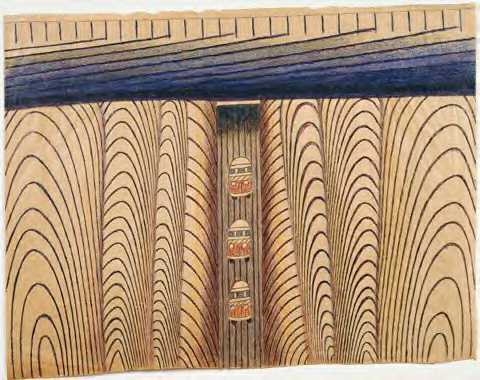
Untitled, Martin Ramirez, Auburn, California, c. 1954
But do not despair, gentle reader.  The post mortem bump can occur for even the most humble of artists.  Here in an excerpt from CBS News, is the story of Martin Ramirez:  
Ramirez was 30 when he left his small ranch in Mexico to seek work in the promised land of America. He hoped to send money back home to his wife and four children, and for a time found work on the railroads in California. But in 1931, destitute and disoriented, he was picked up by police and committed to a psychiatric asylum, where he was diagnosed as catatonic schizophrenic.
Few outsiders ever saw Ramirez, who would spend the rest of his life in mental hospitals. For much of the 32 years he spent in mental institutions, Ramirez lived in silence.
As a student in the 1950s, painter Wayne Thiebaud was allowed to visit him.
"I was surprised because they told us that he was mute and didn't speak," he said. "This would be the kind of thing he'd pull out of his shirt. And it had a picture that I recognized of what I thought was a shoe. And, I asked him, 'Hey, Zapata?' He said - and the first words he spoke all day was - 'Si.' So, I said, 'Do you have other ones like this? Mismo ese?' And, he says, 'Si.'"
For Thiebaud, today a world-renowned artist, Ramirez's work was a revelation.
"What you look for, I think, if you're interested in painting and drawing, are those things which captivate you in some way, which sort of knock you off your feet for a minute," he said. "You don't quite know what's going on. And along that line, his work has this very riveting kind of attention."

Intense and obsessive, Ramirez returned again and again to the same themes. Gun-toting caballeros - he drew more than 80 of them. Trains emerging from tunnels.
"He loved transportation, whether it was a horse, or a truck, or a car or a train. He was rather enamored of that," Thiebaud said.
Self-taught, he used traditional tools like crayons, but in his own way.
"He'd melt down the crayon into wax and he'd apply the wax with a wooden matchstick," Anderson said. "So his stylus, his paintbrush became the wooden matchstick and that's how you get this very rugged line in all of these drawings."

The conditions were anything but ideal for an artist.
"It was not uncommon to have a fight on the ward, that we had to break up, between these more violent patients. So I think Martin was fearful," said James Durfee who supervised the tuberculosis ward at Dewitt State Hospital, where Ramirez was mixed in with 85 other men of all ages.
Ramirez sought refuge by going under tables. Durfee crouched under a table to demonstrate Ramirez's technique. "I saw him do this for hours," Durfee said.
"He used a tongue blade for a ruler. We gave him many rulers. But he used a tongue depressor for a ruler. And a wooden matchstick."

How many drawings Ramirez did isn't really clear. In the early years, the hospital sent many of his works back to his family in Mexico. But when Ramirez's relatives learned he had been in a ward with tuberculosis patients they were afraid the drawings were contaminated so they burned them.
Ramirez's work might not have survived at all if it hadn't been for a professor at Sacramento State College, Tarmo Pasto, who was researching mental illness and creativity. Thiebaud was Pasto's student.

"And he's I think the first one to take him seriously," Thiebaud said.
On visits to Dewitt, Pasto encouraged Ramirez to keep drawing and began to collect his work. Soon Ramirez's pictures were being exhibited in local museums and today at auction can fetch as much as $160,000.
"I think he had no idea he was making art," Thiebaud said. "He just wanted to make these powerful images, which for him was a little kind of world. And those little worlds in painting and drawing are kind of human miracles."
"This piece of a train and a tunnel is built up from lots of different kinds of paper - candy wrapper bow, greeting card, found paper and pages from a book. The title of that book - you're just gonna die - is 'The Man Who Wouldn't Talk,'" Anderson said. "All of a sudden we all just got shivers because you felt like Ramirez was just rising from the grave saying, 'See, you know, I had a voice. I'm declaring that for you. I made a choice not to talk.'"

Drawing by Martin Ramirez

But here the story takes a miraculous turn.

After the Ramirez show opened in New York, Brooke Anderson received an e-mail from a woman who claimed she had "a collection of Martin's drawings."
"I was a little skeptical, as she likes to remind me now," Anderson said.
But the woman, a relative of Max Duneivitz, who'd worked at Dewitt Hospital, e-mailed photographs. The family had nearly thrown the pictures out. They'd barely survived.
"Kept in a pile in a garage in Northern California, on top of a refrigerator, sandwiched between the refrigerator and a sleeping bag," Anderson said. "And I believe at points the owner's cats would sleep on top of the bag."
When Anderson went to California to see them, she couldn't believe her eyes. She was told she had 55 drawings, but it turned out to be more like 140.
"Well, by the time I got to the last one, I think I started crying," Anderson said.
With one discovery, the 300 known works of Martin Ramirez had grown to 440. The new pictures were all drawn in the last years of his life, and some are epic in scale.
There are more of the familiar cowboys, but now blasting trumpets.
"I mean you can hear it," Anderson said. "Because he's just exploded this instrument into this exaggerated form, and it's spectacular."
The American Folk Art Museum is now cataloging the new pictures which will be exhibited next year.   For much of the 32 years he spent in mental institutions, Martin Ramirez lived in silence. But he did speak through his drawings. And as more of his work emerges, we are only just beginning to understand what he was trying to say.
for the full article, visit 
Related Posts with Thumbnails

Contact Me

My photo
Funeral service faces a crisis of relevance, and I am passionate about keeping the best traditions of service alive while adapting to the changing needs of families. Feel free to contact me with questions, or to share your thoughts on funeral service, ritual, and memorialization. dailyundertaker@gmail.com

Followers