Showing posts with label UK. Show all posts

Saturday, November 16, 2013

Sharing a Grave: Urban Cemetery Solutions


I don't know how many times I've heard people say that we're running out of room to bury our dead, so we should all really consider cremation. I might take this seriously from a person who never left a major metropolitan area in their lives, but living as I do in the region know on the coasts as 'Flyover', I know with great certainty that there is enough room to bury everyone in the world in Wisconsin, let alone Nevada or Montana. Anyone who has flown across the country can remember spending hours staring out at countless miles of open land.
Of course this is not what most people would want. We need a place close enough to visit regularly. It needs to be a convenient, serene and attractive place that is appropriate to the spirit and personality of our loved one. Certainly, large areas of open land are not easy to find in heavily populated areas, and in real estate for the living and for the dead, value is dependent upon location.
One of the great benefits of cemeteries is the De facto green spaces and parks that they create after the cities grow around them. If the cemetery hadn't been there, it would just be another neighborhood or strip mall. The reality is though, that when the city grows around the cemetery, there is no room to expand, and solutions must be found.


Here are some ways around the problem. They're not for everybody, but interesting nonetheless. First, via YouTube, an idea to make fuller use of London Cemeteries. It's interesting to keep in mind while you watch this clip, that prior to the introduction of cemeteries in the 1800's, and for a thousand years beforehand, in Europe, burial took place in churchyards (and even inside the churches themselves), and the same graves were used countless times.

Next, here are some photos of cemeteries in overcrowded Hong Kong. When land becomes so valuable and desirable to so many people, we end up living in high rise buildings. In Hong Kong, the dead rest in similar concentrations.

cemetery memorial funeral ideas


cemetery memorial funeral ideas


Finally, can you look at this picture of Nevada and tell me that we've got no room left?

cemetery memorial funeral ideas


Wednesday, November 9, 2011

How to Create a Meaningful Service: Rubber Boots

There is no formula for creating a meaningful funeral, but the recent service held at Cheltenham Crematorium for 39 year old Gloucestershire nurse, Lorna Grant offers some very instructive guidelines.

A powerful and healing message is communicated through these 'mourning garments'

Ms. Grant was a great fan of music festivals, and especially the famous Glastonbury Festival of Contemporary Performing Arts, where people of an independent and alternative bent enjoy tromping about in the mud and listening to music in great numbers each year. In Ms. Grant's service, her fun loving and independent spirit and interests were acknowledged in ways that created a meaningful and loving tribute to her life, along with a healing and affirming experience for her friends and family. Here are some elements of her funeral that we can all bring to our own services...


Undertaker in wellies leads procession to crematorium

The Procession:
If any feature of a funeral sums up our feelings and actions in a symbolic way, it is the procession. The procession lends itself easily to personalized ritual. In Ms. Grant's case, the procession to the crematorium was given added meaning by the vehicle used to transport her remains. A special vehicle and a special pace, marked out in this case by the undertaker, tells us visually and emotionally that this is a special journey, not like any other. It reminds us that we are accompanying a special person on the last leg our their journey.

In the procession we say "Your life and your passing is important enough for me to go with you as far as I can". The special vehicle used for this journey can be a hearse, a horse drawn carriage, or a cart. I have seen processions with motorcycles, hot rods, and milk trucks. In this case the vehicle is special to the memory of the deceased because it is a camper van fitted out to be used as a hearse. We see it and know instantly that it is special and personally meaningful.


Ceremony and innovation

Mixing the old and the new:
There is great value to both traditional ritual and personalization, and when the two are combined, we get fireworks. Ritual provides us with the comforting rhythms and reassurances that allow us to deal with the overwhelming and unknowable. On some level we need to be reminded that this individual and that we ourselves belong to a culture and a tradition and a community. Traditional rituals like the use of pallbearers and processions also communicate emotional messages that are beyond words.

Tradition is cold comfort however, if it is not relevant to the deceased. This is where personalization enhances traditional ritual. In this case, a pink casket that appears to be made of renewable resources is carried by pallbearers wearing the wellington boots that remind us of the muddy music festivals, guests and pallbearers were all invited to wear their 'wellies' to the service. Rather than a traditional floral casket spray, sunflowers are used. I have seen an all female group of bearers carry their former basketball coach into church, clowns carrying a fellow clown, and bearers with a variety of other special attributes. The floral spray for fashion icon, Isabella Blow, was reminiscent of the fabulously edgy millinery she wore. For veterans, a flag often drapes the casket instead of flowers. For race fans, checkered flags can be used. Most importantly, the combination of familiar and novel, makes the messages of both more apparent and meaningful. The pallbearer's work is highlighted by the pink casket and the boots they all wear. The meaning of the sunflowers is emphasized by their placement on the casket.
This is Participation


Participation:
I'll close with a photo very similar to the opening shot because the wellie boots convey the most powerful message for the mourners and for us as more detached observers. Participation was the key to this service and the most important lesson we can take from it. Just attending a funeral service is a form of participation, and sends a wonderful message of comfort and acknowledgement it its own right. Enhancing and increasing the level of participation brings those messages out more clearly and makes the experience of the participant so much more healing.
Participation can take many forms, from eulogies to carrying the casket, to riding in procession, to bringing a hot-dish to the reception. Whether we realize it or not, what we wear to a funeral involves participation too. I am often asked what appropriate clothing should be for funerals and my response would now be to look at the photo above for the answer. A funeral is a special day set aside from other days to remember a special person. When we wear something special to that event we are participating in the funeral. No one expects you to go out and buy a black suit or dress for a funeral, but do take the time and effort to participate in acknowledging the importance of that life and that death by making a special effort. In the case of Ms. Grant, that effort did not even involve suits for anyone other than the pallbearers, it involved wearing rubber boots. By wearing the boots, guests made a visual expression of love and loss in the fun - loving spirit of their friend, and realized on a more profound level why they were there.

We cannot expect to create a meaningful service just by wearing wellies or picking out a pink casket any more that by releasing doves or having an 'open mic' session. A meaningful service is the result of a series of participatory decisions and creative actions. Hopefully what we take away from Lorna Grant's service is a lesson in the importance of ritual, personalization and the creative expression of love.

The photos and information regarding Lorna Grant's service were found on The Daily Mail, This is Somerset, and This is Gloucestershire sites

Wednesday, June 17, 2009

The Shrouded Way, Updated

cremation ritual

The Telegraph published a story yesterday describing council regulations in West Yorkshire, UK, forbidding the combustion of regular street clothing during the cremation process. Apparently, the deceased are now required to be clothed in council approved shrouds. According to the story, reported by Matthew Moore, even colored cotton clothing and soft toys in children's caskets are said to be prohibited in the interests of cleaner emissions.

These regulations are more than heavy handed; they are incredibly out of touch and dehumanising. Certainly cleaner emissions are a laudable goal, and people everywhere can benefit from knowing how to improve them, but a person's clothing and the items that travel with them to the retort are very meaningful and should not be tampered with.

The clothing of the living is an integral part of a person's identity, and removing that layer is dehumanising. For this reason, military recruits are given identical uniforms and haircuts. Their identities must be broken down before they are rebuilt in a new way. This stripping of identity is also a common practice in prisons.

The clothing of the dead is often carefully chosen, sometimes even years in advance. Whether the dead are dressed in overalls, a track suit, a special suit or dress, or even a special T-shirt, that clothing is an expression of who that person was. When the survivors are missing that person, the clothing is an important reminder of the personality they are trying to remember.

A few years ago, the directors at our funeral home worked with the family of a teenage girl who died tragically. Her clothing was very important to her and who she was, and at the request of the family, this young lady wore casual youthful clothing during the evening visitation, and then was changed into more formal clothing for the funeral service the following day. I can't imagine the reaction of family and friends if this girl had been required to wear a utilitarian shroud.

In my experience, every family who loses a child places a special toy, often a stuffed animal made with artificial fibers, into the casket with their baby. Their emotions are complicated and volatile, and one very positive way for them to express their love is by placing these meaningful objects in the casket. The grief experienced by these parents is palpable and overwhelming. If the council prohibits these items, they should be required to tell the parents themselves, face to face, that this baby can't have a comforting toy for the sake of a few fumes.

There are many ways to reduce green house gases and toxins that should be explored before stripping the dead of their indentities and individuality. There are many steps that would have a greater impact on our environment than eliminating stuffed animals and other meaningful gifts from the caskets of children. It is my hope that this council slips out of their own shroud and repeals their ridiculous regulations.

Update, 17 June, 2009

The Daily Mail reported on this situation today. Here is an excerpt from the article. For the full text, visit www.dailymail.co.uk/news/article-1193306/

Grieving relatives have been left distraught after a council banned them from dressing loved ones in their favourite outfits in a crackdown on pollution. It means an end to people being cremated wearing their football shirts, or parents placing soft toys in children's coffins. Kirklees Council in West Yorkshire is the only authority in the country to adopt the approach, according to a national cremation body.

One man, who did not want to be named, was shocked to find his relative could not wear the 100 per cent cotton outfit she had chosen before she died. He said: 'We knew it had to be natural fibres so she chose a top and slip that was 100 per cent cotton. 'But when the funeral director came we were told she would have to wear a special shroud. He pulled out a swatch of different colours to choose from. 'We didn't know what it looked like and when we went to see her in the chapel of rest, we couldn't believe it. 'It was all fluffy and frilly. The deceased would not have wanted to have been seen dead in it - unfortunately she was.' The council set out the guidelines on cremation in a letter to funeral directors.

The document refers to rules in a charter by the Institute of Cemeteries and Crematoria Management (ICCM) which states: 'Clothing the deceased in clothes made of natural fibres/materials is acceptable whereas plastic, nylon and other synthetic materials are not acceptable due to the impact on the environment via emissions.' But Kirklees Council goes on to argue that even natural fibre clothing could contain man-made dyes or fibres that will impact on emissions.

I welcome my UK readers to post any updates on this matter in the comments section.

Friday, March 20, 2009

The Pyre: Fight for open air cremation continues in the UK


Funeral Pyres on the Ganges, Varanasi   ©2007 Lou Montrose

Here is an update to my previous post 'The Pyre'.  Members of England's Hindu minority continue to seek permission to hold open air cremations according to the dictates of their religion.  Here is an excerpt from the Times article by Andrew Norfolk:

Government lawyers will tell a High Court judge next week that allowing an elderly man’s last wish would be abhorrent to the majority of the British population. The man likely to cause such offence is a Hindu aged 70 who wants to follow the dictates of his religion by having a natural cremation on a funeral pyre.  There may be some justification for the Government’s squeamish belief that its citizens would find the traditional funeral rites of a faith with 900 million worldwide adherents “extremely disturbing”.

The National Council for Hindu Priests, in common with most British Hindu organisations, supports the man’s claim, viewing it as “the single most significant campaign to promote Hindu religious freedom in British history”.

Davender Kumar Ghai, the devout Hindu at the centre of the case, fits no one’s idea of a radical minority-rights activist.  He has lived in Britain since 1958, is the founding president of the Anglo-Asian Friendship Society and the holder of a Unesco Peace Gold Medal and an Amnesty International lifetime achievement award.


The Burning of the House of Lords and the House of Commons (1835)  by J.M.W. Turner

Mr Ghai, from Newcastle-upon- Tyne, is in poor health and his final wish is to die in the knowledge that his son will be allowed to set ablaze an open-air pyre that will consume his body but, he believes, liberate his soul.  “I have lived my entire life by the Hindu scriptures. I now yearn to die by them and I do not believe that natural cremation grounds — as long as they were discreet, designated sites far from urban and residential areas — would offend public decency.  “My loyalty is to Britain’s values of fairness, tolerance and freedom. If I cannot die as a true Hindu, it will mean those values have died too.”  He is challenging Newcastle City Council’s refusal to allow a designated site for open-air cremations. If the judicial review is successful, such sites could spring up around the country.


Three years ago, in a secluded field in Northumberland, The Times witnessed the lighting of Britain’s first open-air funeral pyre since the Home Office authorised one for a Nepalese princess at Woking in 1934.  The mother and sister of an Indian man who died aged 31 were among a small group of mourners, led by Mr Ghai, who watched as his body, covered in a white cloth, was placed on the wooden pyre.  A Brahmin priest led chanting as flowers were thrown into the consecrated fire. Incense burnt, water from the Ganges was sprinkled and an earthenware pot smashed to symbolise the soul’s release and rebirth.  The ceremony was held in secret because Newcastle City Council had ruled that it was outlawed by the 1902 Cremation Act. 

 for the full article, visit

http://www.timesonline.co.uk/tol/life_and_style/article5947035.ece?token=null&offset=0&page=1


Wednesday, October 15, 2008

The Pyre: Will Open Air 'Natural' Cremations be Allowed in the UK?

I have been told half seriously by many people that they would like a 'Viking Funeral' where a person's body would drift off into a lake and be consumed by flames. This is a romantic idea and would be a very moving and symbolic ritual, but I have to tell these people "good luck getting away with that!" But what if being consumed on a funeral pyre in the water, or in the open air is a sacrament of your faith, and a strong tradition for you? You would want more than a 'Good Luck' chance of getting away with it, you'd want the assurance that it could legally be done.
In the UK, there is a movement to legalize open air or 'natural' cremation. The government must find a way to balance the religious rights of Hindus with the possible environmental consequences of allowing for such a practice.

The open-air burning of human corpses may be permitted across Britain after a religious charity won a significant victory in its campaign to legalise traditional Hindu funerals.
An attempt to establish the first approved site for the 4,000-year-old spiritual ceremony in northeast England was blocked last year after a local authority ruled that it would breach cremation laws.
The decision was challenged by Davender Kumar Ghai, a 68-year-old devout Hindu who is in poor health and is demanding the right, when he dies, to be cremated on an open-air pyre.
A High Court judge has now approved his bid to seek a judicial review of Newcastle City Council’s refusal to permit a funeral rite that Hindus regard as essential for the successful liberation of the soul.
Mr Justice Collins ruled that it was in the public interest to allow the application because the issue was “of some considerable importance to the Hindu community”. He also noted that rulings in 1884 and 1907 “may mean that the burning of dead bodies in the open air is not necessarily unlawful”.
Britain has 559,000 Hindus and many are expected to opt for an open-air cremation if such ceremonies are approved.
Mr Ghai, the founder and president of the Anglo-Asian Friendship Society, created headlines last July when he arranged the first human funeral pyre in Britain since the Home Office authorised the outdoor cremation of Sumshere Jung, a Nepalese princess and the wife of the Napalese ambassador, in Woking in 1934.
“Hindus are Britain’s third largest faith group. We have proved to be a model migrant community and we feel hurt that other groups are allowed to undertake their funeral rites while we are left out. It is time for that to change,” he said.
-from the Times, for the full article visit http://www.timesonline.co.uk/tol/comment/faith/article1632750.ece

http://student.britannica.com/comptons/art-73281/Mourners-surround-a-funeral-pyre-at-a-cremation-in-Delhi

Blazing row -from The Good Funeral Guide Blog
"The Hindus of Britain have never asked for anything," says Mr Gai of the Anglo-Asian Friendship Society "but we're not asking for much, just to cremate our loved ones in the way our religion says it must be done."
The issue of open-air cremation is hotting up as Newcastle-based Mr Gai prepares to go the High Court next month to demand the right to have his body disposed of in accordance with his religious beliefs.
Mr Gai’s challenge will, doubtless, come down to an evaluation of both the aesthetic and environmental effects of outdoor cremation. It is not long since measures to control foot and mouth disease in the UK blackened the sun and cloaked the countryside with the smoke and stench of burning cattle carcases, so no problem there. But those innocent beasts did not have teeth filled with mercury amalgam, and vaporised mercury is particularly nasty emission.
Let us hope that Mr Gai will be successful and that the judgement will permit open-air cremation for anyone who opts for it. Does that mean that the derelict shipyards of the Tyne will be replaced by burning ghats?
No -- regrettably or otherwise. Open-air cremation is perceived to be a religious requirement only by some Hindus. And for a very few non-Hindus it is an elemental desire which cannot be reduced to a mere reason. It’s a tiny niche market, but one which nevertheless deserves to go the way of its choosing.
Let’s not forget that our ‘bonfire’ derives from the Middle English ‘bone fire’. for the full article, visit http://www.goodfuneralguide.co.uk/blog.html

Even as open air cremations are being considered in the UK, Concerns are being raised about their environmental consequences in India. Following is an excerpt from CBS news.com
Varanasi, the holy city on the Ganges 395 miles southeast of New Delhi, attracts hundreds of thousands of people who cremate their dead and pour the ashes into the river to ensure "moksha," the final liberation of the soul from the endless cycle of reincarnation. The ashes of millions of dead have helped turn the water into a stinking, polluted swirl. Worse, since wood is scarce and expensive, bodies sometimes are thrown into the river half-burned. "Apart from the ashes, this is an even bigger environmental hazard for the Ganges River," said Sunita Narain, an activist with the Center for Science and Environment in New Delhi. Environmentalists prefer electric furnaces because they don't need wood and they reduce the body to a small urnful of powdery ash that does less harm to the rivers. Swami Agnivesh, a Hindu theologian and social activist, says the religion is flexible enough to accept technology. "Many Hindus would welcome the change, especially if they were made aware of the environmental consequences of wood cremation," for the full text, visit http://www.cbsnews.com/stories/2003/07/21/world/main564338.shtml

A Viking Funeral as described in the Sagas
I'm inclined to agree with Mr. Cowling (The Good Funeral Guide), that this type of cremation, if allowed, would be only a niche market, and would not therefore, present much of an environmental issue. After all, how may cords of fire wood are consumed in fireplaces every year? I'm sure that if this is legalized in the UK (or the US for that matter), that regulations would not allow for partially consumed bodies to be left in public water ways. As for fully consumed cremated remains, their presence in water ways is not an issue because they are completely sterile. Unless tons of cremated remains are left in one place, as they are in the Ganges, the effect would be the same as sprinkling sand into the water.
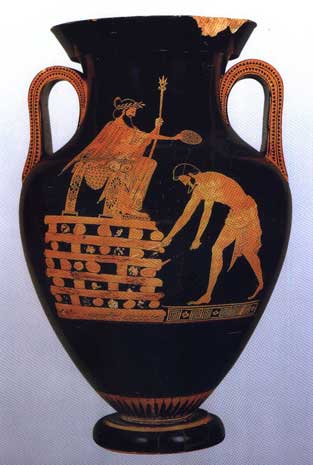
http://www.uoregon.edu/~klio/im/gr/croesus_pyre.jpg

OK, I just couldn't resist showing another Grecian Urn, this one depicting a funeral pyre.


March 2009 update: http://www.dailyundertaker.com/2009/03/pyre-fight-for-open-air-cremation.html

Friday, October 3, 2008

You Say it Best When You..

Sharing memories during a funeral service has become very popular. It is a way for family and friends to participate, to personalize the service, and to make the service reflect the happy memories of a person. Sometimes, though, it is difficult for people to stand up and share in a public place in front of a lot of people. I often suggest that if a family wants this as part of their service, that they have someone agree ahead of time to be the first to share. It's easier then, for others to share. Here are UK celebrant Charles Cowling's experiences and thoughts on the subject.
http://www.goodfuneralguide.co.uk/2008/09/you-say-it-best-when-you.html
You say it best when you...
At yesterday’s funeral I invited people in the audience to have their say after they’d listened to tributes from the family. I tried to make it easy. I gave them time to think about it in advance, acknowledged that speaking in public is hard, invited them to speak from where they were sitting and reminded them that the only thing that mattered was getting it right for their dead friend.
Hardly anyone spoke. I had made an elementary error: I had supposed that their primary medium for expression is words.
I remember planning a funeral with a family, fruitlessly trying to get them to tell me about their dead mum. Very little came until they explained that, as a family, talking was something they just didn’t do. Words, to them, were just so much blather. After some thought, I suggested lighting candles. They weren’t at all the sort of people who like lighting candles, I reckoned, but they leapt at the idea.
On the day of the funeral, I set up my stand, lit a tall candle in the centre and called people forward to light a satellite tealight. Normally, only a few come. On this occasion, everyone did – maybe thirty of them. The array of flames looked very pretty beside the coffin, where they spoke more eloquently than words.
Words are unlikely ever to court disaster so long as they have been checked for precision and cleansed of ambiguity. Saying by doing, though, can be tragic-comically perilous. I’m thinking of the deplorable incident of the dove (symbolic of the soul of the dead person) which, when released, flew inside the crematorium for warmth, could not be chivvied out, and had to be shot. I’m thinking of another dove which, when released, was all at once attacked by a sparrow hawk. As the horrified mourners gazed up, bloody feathers fluttered down on them. I am thinking of the balloon which settled, miles and miles away, in the horns of a £50,000 prize bull. Enraged, the bull burst its fence, charged into a road, was hit by a car and had to be destroyed. These are all true stories.
A piece of music can be eloquent, but only when it is exclusively associated with the dead person. Music so often fails to be effective because those listening to it have their own, private relationship with it.
Back in the here and now, I am chewing over the second lesson I learned from my mute mourners. I had wholly overlooked the fact that they had already done the most eloquent thing they could do for their dead friend. It was this: at some inconvenience to themselves they had made the effort to come to his funeral.

All the bells and all the whistles in all the world cannot speak more meaningfully than simply being there.
This story is from Celebrant Charles Cowling's blog The Good Funeral Guide.
To read the rest of this story, and other thoughtful pieces, visit http://www.goodfuneralguide.co.uk/2008/09/you-say-it-best-when-you.html
Related Posts with Thumbnails

Contact Me

My photo
Funeral service faces a crisis of relevance, and I am passionate about keeping the best traditions of service alive while adapting to the changing needs of families. Feel free to contact me with questions, or to share your thoughts on funeral service, ritual, and memorialization. dailyundertaker@gmail.com

Followers