Previous installments of this series have explored the importance of cemeteries for the maintenance of emotional and historic bonds, ways that cemeteries have adapted to the changing needs and values of families, and the ways that art and cultural traditions enrich the cemetery. Part 5, will take a look at the exciting revitalization taking place at Mountain View Cemetery in Vancouver, British Columbia.
Owned and operated by the City of Vancouver since 1886, Mountain View Cemetery is one of the oldest cemeteries in the metropolitan area. The cemetery is made up of 106 acres of land and features beautiful views of the city and coastal mountains. With over 90,000 grave sites and 145,000 remains interred already, this property had run out of grave sites and was in danger of losing its future.
Following an ambitious revitalization program including an award winning construction project, the cemetery now has a renewed involvement with its community, and for the first time in over 20 years, new spaces are available for purchase. This investment has given Mountain View back it’s future, and showcased the importance of its history. Cemetery Manager, Glen Hodges has graciously agreed to discuss the changes at Mountain View, a wonderful example of making cemeteries relevant.

Pat McNally: In 2000, the city of Vancouver launched a plan to revitalize the historic Mountain View Cemetery. Now, 10 years later, the cemetery is a model for what can be done to make a cemetery relevant. The team at Mountain View has created wonderful new spaces, has engaged the community in activities and discussions, has showcased contemporary arts and facilitated the appreciation of the historical significance of the cemetery and its residents.
What was this process like, and what made it so successful?
Glen Hodges: The process was many things including long, challenging, invigorating, scary, exhilarating, anxious, difficult, etc. Maybe it can best be summarized in one word – monumental (pun intended). The success of our process relied on a number of factors including the many people with a keen interest in making it a success, the City of Vancouver’s desire to be a leader in many things that they do (planning, urban development, the environment etc.), our high cremation rate (>75%) and certainly the unique market conditions in Vancouver – cemetery space here has a higher market value than in most of the rest of the country.

The idea of a cemetery chapel is nothing new, but looking at your Celebration Hall, there is obviously a qualitative difference between this space and traditional chapels. What were the ideas behind Celebration Hall, and how has the space worked out for you so far?
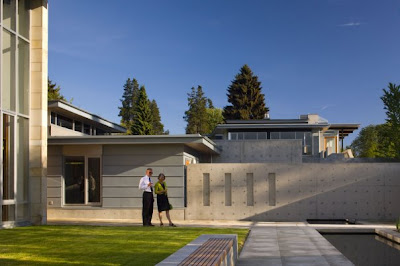
The idea from the very beginning was to create a ‘sacred space’. We were determined to build a facility that was not like any other funeral chapel. The architects and I toured many facilities and were driven to create something that was not ‘residential’ in style or scale. We saw many local facilities that were just like a nice living room - only bigger. We wanted our space to be distinctly different – high ceilings, simple, clean and with very controlled views and courtyards. The result is a very private, contemplative place in the middle of a large active cemetery.
Celebration Hall accommodates screenings and concerts as well as memorial services. What role do you think the arts have to play in a cemetery environment?
I think the arts can, and should, play a much larger part in cemeteries, funerals and other aspects of death - and life. Artisans clearly played a significant part on the commemorative aspects of cemeteries in the past – I am thinking of the monuments that were carved by hand by craftsmen with years of experience. Historically local artists in the community would have participated in may other ways as well – singing, providing music, arranging flowers, and creating memorial items for the funeral or for remembrance after. We have slipped away from these informal community resources to more commercial variations. The experience I have had in the last 6 years with local Vancouver artists has been eye-opening – they are a tremendous resource in ways I never even imagined; providing live acoustic music on the harp, violin, or marimba to vocals, hand made urns, memorial lanterns and shrines.
![loss art=]()
At your Cemetery Forum in April, you sponsored and participated in very important discussions about palliative care, death and dying, the generational importance of cemeteries, and the arts. Please tell us about this forum and what its goals were.
Since the early planning of the Celebration Hall there were ideas of hosting talks that were directly (or even in-directly) related to the cemetery. This symposium was our first attempt to do just that – bring people to the cemetery to learn about death and dying. We started with a thought provoking video about home funerals in the US. This was a great way to jump right in to the some of the very technical challenges of dealing with a deceased person. The morning sessions then focused on providing basic information on what hospices, funeral homes and cemeteries provide. It was definitely not presented to be a sales pitch but more along the lines of “things you should know and consider before you are faced with the inevitable”. The afternoon sessions built upon the basic knowledge and expanded people’s thoughts toward green burial options and the role of artists in meaning and ritual.
You have made a public commitment to increase outreach projects to the community. Do you think that Funeral directors and Cemeterians have a responsibility to inform and educate the communities they work with?
Cemeteries are historically excellent at establishing bylaws and rules about what you cannot do in the cemetery. These are all nicely documented and some cemeteries even post certain excerpts on signs within their property. However, I think we have great room for growth in providing meaningful and important information to our communities before they become clients or visitors. It is easy to inform the people that we come in contact with directly – the pre-need person or maybe the one or two family members making at-need arrangements – but the challenge is getting information to the other people who attend the cemetery service. Maybe even more importantly, what are we doing to reach out to the people who think they don’t need a cemetery – “just scatter my ashes”? How do we reach them so they can consider the impact of their choice on the friends and family that will be left to grieve after their death?

Vancouver enjoys a great cultural diversity, and your cemetery reflects this richness. Many of the ethnic ‘neighborhoods’ have developed organically within the cemetery over the years, but are there any programs or initiatives to celebrate various traditions or spaces created to appeal to different groups at the cemetery?
This was a large part of the thrust behind our first Night For All Souls event in 2005. The artist who came up with the concept, Paula Jardine, was very insightful in borrowing from many cultures and religions, primarily with regard to their various traditions around All Saints Day, All Souls Day and The Day of The Dead. She was very deliberate in trying to create an environment at Mountain View Cemetery that shared some of these other traditions with the public but also in a way that allowed the public to bend, twist and borrow from those traditions the things that resonated with them and then to make them their own. She summed it up greatly the day after the inaugural event when she said that in effect, we were making our own (new) culture! Or at the very least, new cultural traditions.
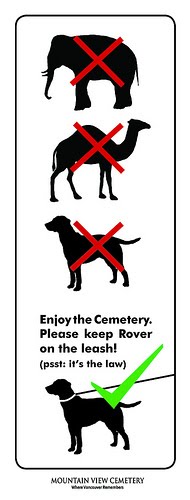
I see that the cemetery has an accommodating policy allowing dogs on leashes. This policy is communicated by some humorous signs! Can you share the story behind these signs and your policy with us?
The position on dogs is primarily a City of Vancouver position – except for designated off-leash parks dogs must be on a leash and controlled by their owner at all times. The cemetery started seeing a large increase in the amount of dogs – especially off leash dogs – in the mid 1990’s. This was a decade after the sale of graves was ceased in 1986 and at a time when the City was considering selling the site to private operators. Once the local dog owner population had established the cemetery as their ‘unofficial’ off-leash park we had a struggle trying to get that genie back in the bottle. About a year ago one of the management staff and her husband had an encounter with a less than cordial dog owner one day. Her husband was aware of a neighbouring municipality that erected ‘camel crossing’ signs in an area prone to speeding - in an effort to slow traffic. The sign worked. He applied the same logic (and humour) to our off-leash dog problem and our no elephant signs were the result. We sent a complimentary sign to a writer from the local paper and ended up with two follow up articles supporting our case and assisting with the communication of our problem.
Bicycles are an issue at many cemeteries these days. Some administrators argue that cemeteries are not playgrounds or thoroughfares, but others go so far as to encourage the bicycling community to bring their activity in to the cemetery. What are your thoughts and policies on bicycles in the cemetery?
Bicycle use in Vancouver is a very current topic. For many years Vancouver has had designated “Greenways” throughout the city – residential roadways that have been partially closed or ‘calmed’ with measures such as speed bumps or roundabouts – that are intended for bike use. One of these ‘greenways’ bisects the cemetery and a result we have a large amount of bicycle traffic through our property. Cycling, jogging, walking – all of these activities are encouraged uses of the cemetery. My concern has always been more with the person’s intent rather than their action. If they are not meaning or causing any harm or disruption I see no concern with cyclists cruising through the cemetery.

Coming up later in July, the cemetery is hosting an Open House featuring a variety of tours, activities and presentations of cultural and historical interest. I applaud you for involving your community in this way. What do you see as the benefits of this involvement – both for the cemetery and for the community?
Much like the symposium on Death and Dying we hosted earlier this year, the Open House is another opportunity for us to invite the public to the cemetery for something other than a funeral. It’s a chance for us to show off our facilities, create a light atmosphere with acoustic music and engage the public to find out more about this mysterious (not-so-scary) place that they all avoid entering. Last year we advertised people to bring a picnic, this year our Artist in Residence will be helping visitors build small kites that will fly without running and with very little wind. I suspect some people may even make their kites a memorial to someone they have lost. We will also be opening up our works yard for people to take a peek at some of the equipment we use to maintain our 106-acre site. This is also a great opportunity for the field staff to engage with the public and share some of their knowledge and expertise. It allows the field staff to more fully participate and share in the success of our redeveloped cemetery. Since we are not open on weekends it also allows us the opportunity to provide additional service to people who cannot come by during weekday hours. The more we can do to make our cemetery a place for the living today, the better chance they will see us as an important place for their loved ones in the future. We want to make it comfortable for them now, so it can provide comfort to them in the future.

Part of the City’s goal in revitalizing the cemetery was certainly an effort to increase the lifespan of interments and allow for new revenues to finance maintenance of the grounds. A result of this was adding new space for cremation interments. What design attributes and decisions went into the creation of these spaces?
Much like the buildings, our design team was not satisfied with the examples that existed in the market place. We set out to create our own vision for what columbaria could (or should) be. This vision also extended to the surroundings that support the cremation spaces. You cannot just purchase a columbaria and plop it down in the middle of an area and call it complete. Well, I guess you can - because that’s what many cemeteries do. However, if you spend some effort on the context or the landscape surrounding the columbaria, you can amplify the impact and really make it an attraction. In our design we pursued a number of objectives and ideals. We were extremely impeded by a lack of space. The cemetery had essentially run out of room in 1986 when graves sales were ceased. We were now left trying to close a few remaining roadways and squeeze these new developments in between the existing graves. Our measurements came down to the millimeter in some cases. At the same time, we were very conscientious about density. Cramming every little last piece of space and converting it to a ‘saleable’ product would negatively impact the entire development and detract from the cemetery – not add to it. With very little space, and almost no public space within the cemetery, we identified two areas where we could actually create some public spaces – with no interment options encroaching the areas. We ended up with reworking an old abandoned fountain in to a much larger fountain and created an entirely new water feature on the other end of the area. We were also careful to create many varied physical and visual entity points throughout the plan so that you never had a sense of being walled, trapped or hidden. Finally, we set out to solve three challenges we had with most of the prevalent columbaria design at the time: why are the niches always arranged in straight rows and columns just like a checkerboard? There must be a better way to attach the niche panels that using the outer rosets? And families clearly want to leave something at the cemetery when they come but on columbaria, unless you glue a bunch of vases to the outside, people are left to clutter all their items at the bottom or else trying to tape/glue/wedge or insert them in-between the niche panels making the whole place look cluttered and messy. In the end we came up with our own design that uses no rosets or outer fasteners to secure the niche panels, has the colums of niches offset – much like the way you would build a stone or brick wall and our design incorporated shelves under each row of niches so visitors would have a place to put their flower, pebble or other trinket when the came to visit.

Are there any cemeteries that you look to for inspiration?
Any cemetery I ever visit is an inspiration in some way. I can get ideas on things I like and things I would never do from any cemetery. When I first started managing a cemetery in 1996 I met Hans Seidenthal. Hans ran the municipal cemetery in Regina, Saskatchewan (my home town) for probably more than 30 years. Hans told me the first question he always asks another cemetery operator is “Show me your mistakes.” When I asked him why he said “So I don’t repeat them.” That has always stuck with me. Sometimes you can learn a lot from what you don’t like at other cemeteries. For positive inspiration the design team put me on to Carlos Scarpa’s cemetery work in Italy. If I am looking for artistic inspiration I am very envious of the work of the Forest Hills Educational Trust in Boston. On a more local level, my colleague Stephen Olson at Royal Oak Burial Park on Vancouver Island is my guide.
What do you see in the future for Mountain View? Are there any new projects on the horizon for this wonderful space?
The future for Mountain View is a steady climb from a forgotten, almost neglected site, to an innovative, thriving and sustainable cemetery that is engaged with the public. We are currently working on some customizable family columbaria units that will enable a family to vary the layout of the niches, choice of stone, incorporate cast glass elements, basalt shelves, built in planters and poetic verse, etc. We are also going to have our first official public art sculpture erected in the next 12 to 18 months. It will be a commemorative piece commissioned by a local ethnic group. I am still trying to expand our online interment listing (~150,000 records and growing) to include links to the marker/headstone image (>50,000 images taken and linked so far- but none online yet…) Oh… and our walking tour in August will be done on bikes!
That sounds wonderful! Thank you so much for sharing your story with us!
To read the previous posts in this series, visit:
originally posted July 2010